Franklin Yard SAT Reading & Writing Guide
How the Test is Organized
Each Reading & Writing module has 27 questions in 32 minutes. You'll complete two modules, with the second adapting to your performance on the first.
Questions appear in clusters by skill type, roughly in this order:
| Order | Category | What It Tests |
|---|---|---|
| 1 | Words in Context | Fill in the blank with the right word |
| 2 | Purpose and Structure | Main purpose, function, structure |
| 3 | Cross-Text Connections | How do two passages relate? |
| 4 | Ideas and Details | Main idea, textual support |
| 5 | Command of Evidence | Which quote/data supports or weakens this claim? |
| 6 | Inference | What logically follows from this? |
| 7 | Standard English Conventions | Punctuation, verb agreement, etc. (not covered in this guide) |
| 8 | Transitions | Which word connects these ideas? |
| 9 | Rhetorical Synthesis | Use these bullet points to accomplish X goal |
Note: Within each cluster, questions go from easiest to hardest. Then difficulty resets when you hit a new cluster. So a hard Words in Context question might be harder than an easy Ideas, Purpose, Structure question that comes right after it.
Time Management
-
Find an order that works for you — Some people go straight through; others prefer to knock out certain question types first. There's no objectively best order, despite what you may have heard. Practice and figure out what you're most comfortable with.
-
Skip when you're stuck, not when you're working — If you're making progress (eliminating answers, understanding the passage), keep going. If you've read it twice and have no idea, flag it and move on.
-
Don't panic after a hard question — You'll have quicker questions later that balance it out. Don't speed up to "catch up" — that causes careless errors.
-
Leave a few minutes at the end — Revisit flagged questions and double-check any you were unsure about.
Words in Context
Words in Context questions appear as a cluster at the beginning of each Reading & Writing module. They ask you to choose the most "logical and precise" word or phrase to fill in the blank.
What They Look Like
In the 1960s, Sam Gilliam, a Black painter from the southern United States, became the first artist to drape painted canvases into flowing shapes. He later explored a different style, ______ quilt-like paintings inspired by the patchwork quilting tradition of Black communities in the South.
Which choice completes the text with the most logical and precise word or phrase?
A) predicting
B) refusing
C) hiding
D) creating
What to Know
The General Approach
Step 1: Read the text.
Step 2: As you read, look for clues that point to the meaning of the blank. There will be several.
Step 3: Predict a word or phrase that fits based on those clues.
Step 4: Pick the answer closest to your prediction. If none match, use process of elimination.
Step 5: Plug the answer back in and re-read to confirm.
The Three Types of Words in Context Questions
Almost every WIC question falls into one of three categories. Identifying the type helps you know what to look for.
| Type | Frequency | What's Happening |
|---|---|---|
| Synonym/Echo | ~75% | The answer matches a word or phrase already in the passage |
| Antonym/Contrast | ~20% | The answer is the OPPOSITE of something in the passage |
| Intensity Shift | ~5% | The answer is a stronger/weaker version of something stated |
Your job: Figure out which type you're dealing with, find the relevant clue, then match.
Type 1: Synonym/Echo (Most Common)
The passage contains a word or phrase that either means the same thing as the correct answer OR directly illustrates it.
Examples of what the "echo" might look like: - A near-synonym: "rushed and hurried" → hasty - A descriptive phrase: "cutting costs wherever possible" → frugal - Characteristics that illustrate the concept: "praised by some, condemned by others" → controversial
Sometimes punctuation helps signal where the clue is:
| Signal | What It Does |
|---|---|
Colon (:) |
Often introduces explanation or elaboration |
Dash (—) |
Often introduces restatement |
Semicolon (;) |
Connects related ideas |
But many questions don't have these signals. The clue might just be a word, phrase, or description elsewhere in the passage that points to the meaning.
Important: The clue is often AFTER the blank. Don't stop reading at the blank—read to the end of the sentence.
Type 2: Antonym/Contrast
When contrast words appear, the blank is the OPPOSITE of what came before.
Contrast signals:
| Word | What It Signals |
|---|---|
| But / However / Instead | Direction shifts |
| Although / While / Though | What follows contrasts with opening |
| Despite / Nevertheless | Reality contrasts with expectation |
Example:
The process was often considered ______ because of its environmental impact. But a new cleaner process has been developed.
"But" signals improvement over the old process. The old process was the opposite of good = inadequate.
The "Despite" Trap
"Despite" signals contrast—but students often get confused about WHICH part the blank refers to.
Despite a growing view that Mandela should have taken greater strides as president, years after his death he continues to be ______ by many worldwide.
Students see criticism in the "despite" clause and pick "criticized." But "despite" means the main clause CONTRADICTS the opening. The answer is the OPPOSITE of the criticism = lauded (praised).
Rule: The blank is in the main clause, so it contradicts the "despite" clause—it doesn't continue it.
Type 3: Intensity Shift (Rare-ish)
The answer goes in the same direction as something in the passage, but stronger or weaker.
Example:
Pennington made a "substantial impact" on society, but her place in our historical memory is perhaps more ______ than Kwolek's, who will long be remembered.
We need something WEAKER than "long remembered." The answer is tentative (uncertain, shaky).
Don't Fear Simple Answers
About half of correct answers are "simple" words: ongoing, value, important, collected, different.
"Too obvious" is NOT a reason to eliminate. The SAT tests precision, not vocabulary difficulty. If a simple word matches the context perfectly, it's probably right.
What If You Don't Know a Word in the Answer Choices?
Don't panic—this happens. Here's what to do:
1. Stick with your prediction. If you have a solid prediction based on the clues, trust it. Eliminate the answers you do know that don't match.
2. Use process of elimination. Every wrong answer you eliminate improves your odds. Even if you can only cross off two choices, you've gone from 25% to 50%.
3. An imperfect match is a wrong match. If a word is close but not quite right—eliminate it. The unknown word might be right; the imperfect one almost definitely isn't.
4. Make your best guess and move on. Don't dwell.
Examples
Example 1
Studying how workload affects productivity, Maryam Kouchaki and colleagues found that people who chose to do relatively easy tasks first were less ______ compared to those who did hard tasks first. Finishing easy tasks gave participants a sense of accomplishment, but those who tackled hard tasks first actually became more skilled and productive workers over time.
Which choice completes the text with the most logical and precise word or phrase?
A) secretive
B) efficient
C) outgoing
D) unsympathetic
Before reading the solution: Cover the answers. What clues do you see? What word would YOU put in the blank?
Solution
Step 1: Find the clues.
| Clue | What it tells us |
|---|---|
| "Studying how workload affects productivity" | The topic is productivity |
| "less ______ compared to" | This is a comparison—the blank is something negative for the easy-tasks group |
| "became more skilled and productive workers" | The hard-tasks group became productive, so the easy-tasks group must be less so |
Step 2: Predict.
We need something like "productive" or "effective."
Step 3: Match to answers.
| Answer | Verdict |
|---|---|
| A) secretive | ✗ Not related to productivity |
| B) efficient | ✓ Matches "productive/effective" |
| C) outgoing | ✗ About personality, not productivity |
| D) unsympathetic | ✗ About emotions, not productivity |
Step 4: Plug back in.
"...people who chose to do relatively easy tasks first were less efficient compared to those who did hard tasks first." ✓
Answer: B) efficient
Note: This is why covering the answers matters. If you'd seen "secretive" or "outgoing" first, you might have tried to make them work. But with a prediction in mind, you immediately recognize they're off-topic.
Example 2
Particle physicists like Ayana Holloway Arce and Aida El-Khadra spend much of their time ______ what is invisible to the naked eye: using sophisticated technology, they closely examine the behavior of subatomic particles, the smallest detectable parts of matter.
Which choice completes the text with the most logical and precise word or phrase?
A) selecting
B) inspecting
C) creating
D) deciding
Before reading the solution: Cover the answers. What clues do you see? What word would YOU put in the blank?
Solution
Step 1: Find the clues.
| Clue | What it tells us |
|---|---|
| "spend much of their time ______ what is invisible" | They're doing something with invisible things |
| The colon (:) | What follows will explain or define the blank |
| "they closely examine the behavior" | This defines what they spend their time doing |
Step 2: Predict.
We need something like "examining" or "studying."
Step 3: Match to answers.
| Answer | Verdict |
|---|---|
| A) selecting | ✗ Means choosing, not examining |
| B) inspecting | ✓ Means to examine closely |
| C) creating | ✗ Means making something new |
| D) deciding | ✗ Means making a choice |
Step 4: Plug back in.
"Particle physicists spend much of their time inspecting what is invisible to the naked eye." ✓
Answer: B) inspecting
Example 3
The process of mechanically recycling plastics is often considered ______ because of the environmental impact and the loss of material quality that often occurs. But chemist Takunda Chazovachii has helped develop a cleaner process of chemical recycling that converts superabsorbent polymers from diapers into a desirable reusable adhesive.
Which choice completes the text with the most logical and precise word or phrase?
A) resilient
B) inadequate
C) dynamic
D) satisfactory
Before reading the solution: What contrast signal do you see? What does it tell you about the blank?
Solution
Step 1: Find the clues.
"But" signals a shift—the new process is better, so the old process must be worse.
- Old process: "environmental impact" + "loss of material quality" = negative
- "But" = shift
- New process: "cleaner," "desirable reusable adhesive" = positive
Step 2: Predict.
The old process is bad/flawed/not good enough. We need a negative word.
Step 3: Match to answers.
| Answer | Verdict |
|---|---|
| A) resilient | ✗ Positive word (strong, recovers well) |
| B) inadequate | ✓ Negative—means not good enough |
| C) dynamic | ✗ Positive word (energetic, changing) |
| D) satisfactory | ✗ Positive word (good enough) |
Step 4: Plug back in.
"The process of mechanically recycling plastics is often considered inadequate because of the environmental impact..." ✓
Answer: B) inadequate
Practice
Now try these on your own. For each one: 1. Cover the answer choices 2. Find the clues and predict a word 3. Then look at the choices and pick the best match
(Answers at the end of this section)
Practice 1 (Easy)
The spacecraft OSIRIS-REx briefly made contact with the asteroid 101955 Bennu in 2020. NASA scientist Daniella DellaGiustina reports that despite facing the unexpected obstacle of a surface mostly covered in boulders, OSIRIS-REx successfully ______ a sample of the surface, gathering pieces of it to bring back to Earth.
A) attached
B) collected
C) followed
D) replaced
Think: What phrase after the blank explains what OSIRIS-REx did?
Practice 2 (Easy)
Beginning in the 1950s, Navajo Nation legislator Annie Dodge Wauneka continuously worked to promote public health; this ______ effort involved traveling throughout the vast Navajo homeland and writing a medical dictionary for speakers of Diné bizaad, the Navajo language.
A) impartial
B) offhand
C) persistent
D) mandatory
Think: What word describes the nature of her work?
Practice 3 (Easy)
Handedness, a preferential use of either the right or left hand, typically is easy to observe in humans. Because this trait is present but less ______ in many other animals, animal-behavior researchers often employ tasks specially designed to reveal individual animals' preferences for a certain hand or paw.
A) recognizable
B) intriguing
C) significant
D) useful
Think: What contrast is being set up between humans and animals?
Practice 4 (Medium)
In Nature Poem (2017), Kumeyaay poet Tommy Pico portrays his ______ the natural world by honoring the centrality of nature within his tribe's traditional beliefs while simultaneously expressing his distaste for being in wilderness settings himself.
A) responsiveness to
B) ambivalence toward
C) renunciation of
D) mastery over
Think: What different feelings does Pico express toward nature?
Practice 5 (Medium)
The güiro, a musical instrument traditionally made from a dried and hollowed gourd, is thought to have originated with the Taíno people of Puerto Rico. Players use a wooden stick to scrape along ridges cut into the side of the gourd, creating sounds that are highly ______: the sounds produced by güiros can differ based on the distance between the ridges, the types of strokes the player uses, and the thickness of the gourd.
A) overlooked
B) powerful
C) routine
D) variable
Think: What does the colon introduce? What does that tell you about the sounds?
Practice 6 (Medium)
The following text is adapted from James Baldwin's 1956 novel Giovanni's Room. The narrator is riding in a taxi down a street lined with food vendors and shoppers in Paris, France.
The multitude of Paris seems to be dressed in blue every day but Sunday, when, for the most part, they put on an unbelievably festive black. Here they were now, in blue, disputing, every inch, our passage, with their wagons, handtrucks, their bursting baskets carried at an angle steeply self-confident on the back.
As used in the text, what does the word "disputing" most nearly mean?
A) Arguing about
B) Disapproving of
C) Asserting possession of
D) Providing resistance to
Think: What are the vendors doing to the taxi's passage?
Practice 7 (Medium-Hard)
Within baleen whale species, some individuals develop an accessory spleen—a seemingly functionless formation of splenetic tissue outside the normal spleen. Given the formation's greater prevalence among whales known to make deeper dives, some researchers hypothesize that its role isn't ______; rather, the accessory spleen may actively support diving mechanisms.
A) replicable
B) predetermined
C) operative
D) latent
Think: What contrast does "rather" signal? What's the opposite of "actively support"?
Practice 8 (Hard)
The invertebrates Haywardozoon pacificum and Trophontera mangani have recently been discovered inhabiting the Clarion-Clipperton Zone (CCZ), an area of abyssal plain between Hawaii and Mexico where mining is permitted. The number of other invertebrates that may inhabit the CCZ is currently ______, as the area's biota is poorly sampled and the few samples that have been taken cannot be presumed to be representative.
A) infinitesimal
B) verifiable
C) tenuous
D) inestimable
Think: If sampling is poor and unrepresentative, what can we say about the number?
Practice Answers
Click to reveal answers
Practice 1: B) collected "Gathering pieces of it to bring back to Earth" directly defines what OSIRIS-REx did = collected. (Synonym/Echo)
Practice 2: C) persistent "Continuously worked" is the key clue. Continuous = persistent = ongoing. (Synonym/Echo)
Practice 3: A) recognizable In humans, handedness is "easy to observe." In animals, it's "less ______" = less easy to observe = less recognizable. (Antonym/Contrast—the trait exists but is harder to see)
Practice 4: B) ambivalence toward "Honoring" (positive) + "distaste" (negative) connected by "while simultaneously" = mixed feelings = ambivalence. (Synonym/Echo—the passage defines the blank)
Practice 5: D) variable The colon introduces an explanation: sounds "can differ" based on multiple factors. Can differ = variable. (Synonym/Echo with colon signal)
Practice 6: D) Providing resistance to The vendors with their wagons, handtrucks, and baskets are blocking/resisting the taxi's passage through the street. They're not literally arguing (A) or disapproving (B). (Context-based meaning)
Practice 7: D) latent "Rather" signals contrast. The hypothesis: the role isn't ______, rather it "actively supports." Actively support ≠ inactive/dormant. Latent = dormant, inactive. So the role ISN'T latent (inactive)—it IS active. (Antonym/Contrast)
Practice 8: D) inestimable "Poorly sampled" + "cannot be presumed to be representative" = we can't estimate the number. Inestimable = cannot be estimated. (Synonym/Echo—the explanation defines the blank)
General Advice for "Reading Questions"
Purpose, Structure, Ideas, Details, Cross-Text Connections, Command of Evidence, and Inference questions all share something in common: they ask you to understand what a passage says or does. The answer is essentially in the passage—it's about literal comprehension.
While the test treats these as separate categories, they share a similar approach. The strategies below apply across all of them.
What to Know
Careful Reading
The most important skill you can cultivate on the verbal section is very careful reading. You'll need to read everything more carefully than you've done for any text in your life.
Read the whole passage. Don't skim or skip ahead to the question. The answer often depends on details at the end of the passage, or on how the beginning and end connect. Read every sentence.
Understand before you answer. Don't rush to the choices. Make sure you actually understand what the passage is saying—the relationships between ideas, who's claiming what, what the evidence supports.
Don't Get Stuck on Unfamiliar Terms
Passages often contain technical vocabulary—scientific terms, historical names, specialized jargon. You don't need to understand every word to answer the question. Focus on the relationships between ideas: who claims what, what supports what, what contrasts with what. The unfamiliar terms are usually just labels for concepts the passage explains.
Process of Elimination
Don't just read the answers and wait for one to "feel right." Be systematic:
- Read the passage carefully (twice if needed)
- Go answer by answer with laser focus on ONE at a time
- For each answer, decide: yes or no? And specifically why yes or no?
- If the first answer seems wrong, keep going—check ALL four before deciding
- Don't jump around—work through A, B, C, D in order
This discipline prevents you from latching onto a "pretty good" answer while missing the correct one.
Think Like a Prosecutor
When evaluating answer choices, think of yourself as a prosecutor trying to convict each wrong answer—not a defense attorney trying to make answers work.
For each answer choice, ask:
- "What's the evidence that this answer is guilty of being wrong?"
- "Can I point to a specific word or phrase that doesn't match the text?"
- "Is there anything in this answer I can't prove with the passage?"
If you can build a case against an answer—find even one word that's unsupported, too extreme, or twisted from the text—eliminate it. The answer you can't convict is your answer.
Answers are Not Subjective
We're used to the idea that interpretation of texts is subjective.
But SAT Reading questions can't work like that.
The test has to be 100% objective, otherwise you'll have 50,000 parents calling the SAT customer service line arguing that their kid's answers were actually right.
How does the SAT deal with this?
They write the questions so that people can't disagree on the right and wrong answers. There is only one objectively correct interpretation—and only one objectively correct answer.
The Correct Answer Must:
- Be supported by textual evidence
- Answer the question being posed
If an answer fails either test, it's wrong.
When You're Stuck Between Two
Stop trying to pick the "right" one.
Instead, focus on finding the flaw in each. One of them will have a weakness you can exploit.
Predicting the Answer
Before looking at the answer choices, take 10-15 seconds to form your own expectation based on what the passage says. If nothing comes to you, just move to the answers—don't force it.
Even a wrong prediction can be helpful. The act of thinking about what the answer should say before you look keeps you grounded in the passage and less likely to get pulled toward attractive-sounding wrong answers.
Some question types are much better suited for prediction than others, and it's not always clear which until you try. But the habit of pausing to think before you look at answers is valuable across the board.
Passage Patterns to Watch For
Contrast Signals
Words like "but," "however," "yet," "although," "nevertheless," and "despite" signal a shift. Understanding that shift—what changed, what's different, what's being contrasted—is often key to answering the question.
For instance, a common type of contrast: something SEEMS one way but IS actually another. The test wants you to understand both sides of this distinction and how they connect.
"Her performances appear spontaneous... however, this is due to tremendous preparation."
Causal Chains
Many passages establish causal relationships—one thing leads to another.
Shark decline → ray increase → oyster decline
Understanding these chains helps across many question types:
- What causes what?
- Are things directly related (A↑ → B↑) or inversely related (A↑ → B↓)?
Recognizing these relationships—and whether evidence supports or breaks them—is key to answering questions about claims, inferences, and main ideas.
Practice: Find the Flaws
Here's a passage with answer choices. Your job: identify what's wrong with each wrong answer before reading the explanations.
In West Africa, jalis have traditionally been keepers of information about family histories and records of important events. They have often served as teachers and advisers, too. New technologies may have changed some aspects of the role today, but jalis continue to be valued for knowing and protecting their peoples' stories.
Which choice best states the main idea of the text?
A) Jalis are the primary educators in West Africa.
B) Jalis are now using technology to do much of their work.
C) Jalis believe that an understanding of a people's history benefits future generations.
D) Jalis have long performed a critical role in West African culture, and that role has continued to expand over time.
E) Jalis serve as repositories of genealogical and historical knowledge.
F) Jalis have abandoned their traditional role in favor of modern technology.
G) Traditional cultural roles in Africa have persisted despite technological change.
H) Even though there have been some changes in their role, jalis continue to preserve their communities' histories.
Stop here. If you think an answer is wrong, write down why.
Explanations
A) Jalis are the primary educators in West Africa. ✗ One word off + Extreme language. "Primary" is too strong—the text says they "have often served as teachers," not that teaching is their primary role.
B) Jalis are now using technology to do much of their work. ✗ Twists the details. The text says technology "changed some aspects of the role"—not that jalis use technology.
C) Jalis believe that an understanding of a people's history benefits future generations. ✗ Reasonable but not supported. This sounds nice, but the text never says what jalis believe.
D) Jalis have long performed a critical role in West African culture, and that role has continued to expand over time. ✗ Half right, half wrong. They have performed a critical role, but it hasn't "expanded"—it has continued despite changes.
E) Jalis serve as repositories of genealogical and historical knowledge. ✗ Not comprehensive + Doesn't answer the question. This is true, but it only describes part of the passage. It misses the main point about their enduring role despite changes. (This would be correct if the question asked: "According to the passage, what function have jalis served in West African communities?")
F) Jalis have abandoned their traditional role in favor of modern technology. ✗ Opposite/Contradiction. The passage says jalis continue to be valued—the opposite of abandoning their role.
G) Traditional cultural roles in Africa have persisted despite technological change. ✗ Too broad. The passage is specifically about jalis in West Africa, not "traditional cultural roles in Africa" generally.
H) Even though there have been some changes in their role, jalis continue to preserve their communities' histories. ✓ CORRECT. This captures the main idea—jalis preserve history, and while things have changed, they're still valued for this.
Wrong Answer Traps
Wrong answers can be wrong in subtle ways. Here they are, ordered roughly from most obviously wrong to most subtly wrong:
| Trap Type | What It Does |
|---|---|
| Opposite/Contradiction | Says the reverse of what the passage says |
| Twists the details/relationship | Uses words from the passage but changes the meaning or reverses the relationship |
| One word off | Almost right, but one word makes it wrong |
| Half right, half wrong | Part of the answer checks out, part doesn't |
| Too broad | Takes something true about X and claims it's true about a larger category |
| Extreme language* | "Always," "never," "only," "all" without evidence to match |
| Reasonable but not supported | Sounds true, but the text never says it |
| Doesn't answer the question | True statement, but not what was asked |
| Not comprehensive (Main Idea/Purpose only) | Only covers part of the passage, not the whole thing |
*Extreme Language = High Burden of Proof
Words like "always," "never," "only," "all," "none," "primary," "most important" carry a high burden of proof. If the text says a scientist "often" studies birds, an answer saying she "exclusively" studies birds is wrong—"exclusively" is a bigger claim than the text supports.
(See "Think Like a Prosecutor" above—treat extreme words as evidence to build your case against an answer.)
Purpose, Structure, Ideas, Details
Main Purpose and Main Idea
Main Purpose asks why the author wrote this ("The author wrote this in order to..."). Main Idea asks what the central point or takeaway is. They're related—and the strategies overlap.
What They Look Like
The following text is from Lucy Maud Montgomery's 1908 novel Anne of Green Gables. Anne, an eleven-year-old girl, has come to live on a farm with a woman named Marilla in Nova Scotia, Canada.
Anne reveled in the world of color about her.
"Oh, Marilla," she exclaimed one Saturday morning, coming dancing in with her arms full of gorgeous boughs, "I'm so glad I live in a world where there are Octobers. It would be terrible if we just skipped from September to November, wouldn't it? Look at these maple branches. Don't they give you a thrill—several thrills? I'm going to decorate my room with them."
"Messy things," said Marilla, whose aesthetic sense was not noticeably developed. "You clutter up your room entirely too much with out-of-doors stuff, Anne. Bedrooms were made to sleep in."
Which choice best states the main purpose of the text?
A) To demonstrate that Anne has a newly developed appreciation of nature
B) To describe an argument that Anne and Marilla often have
C) To emphasize Marilla's disapproval of how Anne has decorated her room
D) To show that Anne and Marilla have very different personalities
What to Know
The General Approach
Step 1: Read the question, then read the text.
Step 2: As you read, ask: What is the author's main point? Why did they write this?
Step 3: Before looking at answers, summarize the main idea or purpose in ~10 words.
Step 4: Use process of elimination until you're down to one answer.
Watch Out For: Answers that accurately describe part of the passage but miss the overall point—only covering the first paragraph, focusing on one example instead of the main argument, or capturing a supporting detail rather than the central claim. The correct answer must account for the whole passage.
Examples
Example: Main Purpose
When classical pianist Martha Argerich performs, it appears as if the music is coming to her spontaneously. She's highly skilled technically, but because of how freely she plays and her willingness to take risks, she seems relaxed and natural. Her apparent ease, however, is due to a tremendous amount of preparation. Despite Argerich's experience and virtuosity, she never takes for granted that she knows a piece of music. Instead, she approaches the music as if encountering it for the first time and tries to understand it anew.
Which choice best states the main purpose of the text?
A) To provide details about how Argerich identifies which pieces of music she will perform
B) To assert that Argerich's performances look effortless because of how she prepares for them
C) To discuss the kinds of music Argerich feels most comfortable encountering for the first time
D) To describe the unique way that Argerich approaches music she hasn't performed before
STOP — Try this yourself first. What does "appears... however" signal? Predict the main purpose before looking at answers.
Solution
Step 1: Summarize the main purpose in ~10 words.
She looks effortless, but it's actually from intense preparation.
Step 2: Match to answers.
| Answer | Evaluation |
|---|---|
| A) How she identifies pieces to perform | ✗ Never mentioned—adds information not in the text |
| B) Effortless because of preparation | ✓ Matches our summary exactly |
| C) Feels comfortable encountering music for the first time | ✗ "Feels most comfortable" projects an emotion. She approaches music as if new—that's a technique, not a preference |
| D) Approaches music she hasn't performed before | ✗ Misreads the passage—she approaches familiar music as if it were new |
Answer: B
Function Questions
Function questions ask what role an underlined sentence plays in the passage—what it DOES in the context of the passage.
What They Look Like
When ancient oak planks were unearthed during subway construction in Rome, Mauro Bernabei and his team examined the growth rings in the wood to determine where these planks came from. By comparing the growth rings on the planks to records of similar rings in oaks from Europe, the team could trace the wood to the Jura region of France, hundreds of kilometers from Rome. Because timber could only have been transported from distant Jura to Rome by boat, the team's findings suggest the complexity of Roman trade routes.
Which choice best describes the function of the underlined sentence in the text as a whole?
A) It presents a conclusion about Roman trade routes based on the team's findings.
B) It questions how the team was able to conclude that the planks were used to build a boat.
C) It explains why the planks were made from oak rather than a different kind of wood.
D) It describes common methods used in Roman subway construction.
What to Know
The General Approach
Step 1: Read the question, then read the text.
Step 2: As you read, pay attention to what comes BEFORE and AFTER the underlined portion—function is determined by position.
Step 3: Before looking at answers, ask: "If I removed this sentence, what would the passage lose?" Name the function in your own words.
Step 4: Use process of elimination until you're down to one answer.
Watch Out For: Answers that describe the function of a different part of the text, not the underlined portion.
Common Function Patterns
| What Comes Before | Underlined Sentence Does | Function |
|---|---|---|
| General claim | Specific example | Illustrate |
| Claim or topic | More detail about how it works | Elaborate |
| One perspective | Opposing perspective | Contrast/Challenge |
| Main argument | Limitation or exception | Qualify (meaning: add a limitation or caveat) |
| Nothing (first sentence) | Sets up what follows | Introduce |
Examples
Example: Function
"How lifelike are they?" Many computer animators prioritize this question as they strive to create ever more realistic environments and lighting. Generally, while characters in computer-animated films appear highly exaggerated, environments and lighting are carefully engineered to mimic reality. But some animators, such as Pixar's Sanjay Patel, are focused on a different question. Rather than asking first whether the environments and lighting they're creating are convincingly lifelike, Patel and others are asking whether these elements reflect their films' unique stories.
Which choice best describes the function of the underlined question in the text as a whole?
A) It represents a concern of computer animators who are more interested in creating unique backgrounds and lighting effects than realistic ones.
B) It conveys the uncertainty among many computer animators about how to create realistic animations using current technology.
C) It illustrates a reaction that audiences typically have to the appearance of characters created by computer animators.
D) It reflects a primary goal that many computer animators have for certain components of the animations they produce.
STOP — Try this yourself first. What does the sentence after the question tell you? Is this question representing the author's view, or someone else's?
Solution
Step 1: Look at what comes after the underlined portion.
The sentence right after says: "Many computer animators prioritize this question."
Step 2: Ask "If I removed this sentence, what would the passage lose?"
Without this question, we wouldn't know what goal animators are working toward. It establishes their priority.
Step 3: Match to answers.
| Answer | Verdict |
|---|---|
| A) | ✗ This describes Patel's view (different question), not the underlined question |
| B) | ✗ Not about uncertainty—it's about priority |
| C) | ✗ Nothing about audience reactions |
| D) | ✓ "Primary goal" matches "prioritize this question" |
Answer: D
Note: Watch for answer choice language. "Uncertainty" (B) and "concern" suggest doubt or worry. "Primary goal" (D) suggests purpose and priority. The passage says animators "prioritize" this question—that's goal language, not uncertainty language.
Structure Questions
Structure questions ask how the passage is ORGANIZED—the arrangement of ideas, not their content.
What They Look Like
The Vizcaya is just one of approximately three million known historical shipwrecks spread throughout the world's oceans, and their impact on sea life and underwater ecosystems is of great interest to researchers. Rachel Mugge and colleagues were particularly curious about the effects of wooden shipwrecks on seafloor microbial communities. The researchers studied two wooden shipwrecks in the Gulf of Mexico by placing pieces of pine and oak between zero and 200 meters away from each shipwreck to collect samples of three kinds of microbes: bacteria, archaea, and fungi. They found that across the three microbial communities, peak diversity and richness was observed on pine and oak samples placed approximately 125 meters from the shipwrecks.
Which choice best describes the overall structure of the text?
A) It states the number of known shipwrecks, describes the historical significance of one of those shipwrecks, and then comments on the various microbes found at the shipwreck site.
B) It introduces a study of microbial communities near shipwrecks that has received significant scholarly attention, summarizes the results of that study, and then describes a research team's reaction to the study.
C) It names a famous historical shipwreck, describes the type of wood used to build that ship, and then explains how that wood type influences underwater microbial communities.
D) It notes a general scientific interest in shipwrecks' ecological effects, describes a specific study related to that interest, and then states one of the study's findings.
What to Know
The General Approach
Step 1: Read the question, then read the text.
Step 2: As you read, map the passage in parts. What does Part 1 do? Part 2? Part 3?
Step 3: Before looking at answers, describe the structure in your own words. (e.g., "States a claim, then gives evidence, then notes a limitation")
Step 4: Use process of elimination until you're down to one answer. (All parts must match.)
Watch Out For: Structure answers are always multi-part, so the "half right, half wrong" trap is especially common. Check that every part of the answer matches the passage—one wrong piece disqualifies the whole thing.
Common Structure Patterns
| Pattern | Signal Words |
|---|---|
| General → Specific | "For example," "One study," "Consider..." |
| Chronological | "First," "Then," "Subsequently," "Finally" |
| Reverse Chronological | "A decade earlier," "Previously," "Before that" |
| Problem → Solution | Question mark opening, "To address this" |
| Claim → Evidence | "This is shown by," "Evidence includes" |
Examples
Example: Structure
The Vizcaya is just one of approximately three million known historical shipwrecks spread throughout the world's oceans, and their impact on sea life and underwater ecosystems is of great interest to researchers. Rachel Mugge and colleagues were particularly curious about the effects of wooden shipwrecks on seafloor microbial communities. The researchers studied two wooden shipwrecks in the Gulf of Mexico by placing pieces of pine and oak between zero and 200 meters away from each shipwreck to collect samples of three kinds of microbes: bacteria, archaea, and fungi. They found that across the three microbial communities, peak diversity and richness was observed on pine and oak samples placed approximately 125 meters from the shipwrecks.
Which choice best describes the overall structure of the text?
A) It states the number of known shipwrecks, describes the historical significance of one of those shipwrecks, and then comments on the various microbes found at the shipwreck site.
B) It introduces a study of microbial communities near shipwrecks that has received significant scholarly attention, summarizes the results of that study, and then describes a research team's reaction to the study.
C) It names a famous historical shipwreck, describes the type of wood used to build that ship, and then explains how that wood type influences underwater microbial communities.
D) It notes a general scientific interest in shipwrecks' ecological effects, describes a specific study related to that interest, and then states one of the study's findings.
STOP — Try this yourself first. Map the passage in parts. What does each part do? Describe the structure before looking at answers.
Solution
This is a General → Specific → Finding structure:
- Part 1: "Their impact on sea life... is of great interest to researchers" = General interest
- Part 2: "Rachel Mugge and colleagues... studied two wooden shipwrecks" = Specific study
- Part 3: "They found that... peak diversity and richness was observed..." = One finding
Apply the "Both Parts Must Match" rule:
| Answer | Check Each Part |
|---|---|
| A) | ✗ The passage doesn't describe "historical significance" of the Vizcaya |
| B) | ✗ The passage doesn't say the study "received significant scholarly attention" |
| C) | ✗ The Vizcaya isn't described as "famous," and the passage doesn't say what wood that ship was made of |
| D) | ✓ General interest ✓, specific study ✓, states finding ✓ |
Answer: D
Details Questions
"According to the text" and "Based on the text" mean: find where the passage DIRECTLY SAYS this.
What They Look Like
Xin Wang and colleagues have discovered the earliest known example of a flower bud in a 164-million-year-old plant fossil in China. The researchers have named the new species Florigerminis jurassica. They believe that the discovery pushes the emergence of flowering plants, or angiosperms, back to the Jurassic period, which occurred between 145 million and 201 million years ago.
According to the text, how old was the fossil that Wang and colleagues discovered?
A) 150 million years old
B) 145 million years old
C) 164 million years old
D) 201 million years old
What to Know
The General Approach
Step 1: Read the question, then read the text.
Step 2: As you read, locate the specific information the question asks for.
Step 3: Use process of elimination until you're down to one answer. (If you can't point to it in the text, eliminate it.)
Example: Question asks what material Villasana uses. Passage states: "applying colorful yarn" Answer: "Yarn" ← Direct match. You can point to it.
Examples
Example: Details
In what is now New Mexico, the Pueblo of Pojoaque operates the Poeh Cultural Center. Relying on traditional knowledge to guide the design of exhibits, this institution presents Pojoaque history and culture to the tribe's citizens. The Tohono O'odham Nation, a tribe in Arizona, employs a similar strategy in its own cultural center. Both centers contrast with museums that aren't Indigenous-led; when displaying Indigenous artifacts, such museums tend to anticipate mainly non-Indigenous audiences and rely on Euro-centric strategies for designing exhibits.
According to the text, what is one way that non-Indigenous museums typically differ from the cultural centers operated by the Pueblo of Pojoaque and the Tohono O'odham Nation?
A) The museums typically feature fewer artifacts in their exhibits.
B) The museums are often somewhat smaller in size.
C) The museums are largely aimed at non-Indigenous audiences.
D) The museums focus on tribal history as well as tribal culture.
STOP — Try this yourself first. Find the exact phrase in the passage that describes how non-Indigenous museums differ.
Solution
Find the exact statement about non-Indigenous museums:
"such museums tend to anticipate mainly non-Indigenous audiences"
Match to answer choices:
| Answer | Evaluation |
|---|---|
| A) Feature fewer artifacts | ✗ Quantity of artifacts never mentioned |
| B) Smaller in size | ✗ Size never mentioned |
| C) Aimed at non-Indigenous audiences | ✓ Direct paraphrase of "tend to anticipate mainly non-Indigenous audiences" |
| D) Focus on tribal history and culture | ✗ The passage says INDIGENOUS-LED centers present history and culture—not non-Indigenous museums |
Answer: C
Practice
Practice 1: Titanosaur Nesting Site (Details — Easy)
Paleontologist Lucas E. Fiorelli and colleagues have reported the discovery at a mine in Brazil of several egg clutches, partially preserved single eggs, and egg shells from the Late Cretaceous period. The researchers have concluded that the area was once a nesting and breeding site for titanosaurs, a group of sauropod dinosaurs. The finding is significant given the previous lack of known nesting sites in northern regions of South America, which led many paleontologists to assume that titanosaurs migrated south to lay eggs.
What does the text most strongly suggest about the site discovered by the researchers?
A) It is the earliest known example of a titanosaur nesting and breeding site.
B) It was very difficult to excavate given that it was discovered in a mine.
C) It may have been occupied by other sauropods in addition to titanosaurs.
D) It is farther north than any other nesting site discovered in South America.
Think: The text says the finding is "significant" because of a "previous lack" of something. What was lacking? What assumption did that create? Find the exact phrase that tells you why this site matters.
Practice 2: Literary Critic (Details — Easy)
The Skin I'm In was Sharon G. Flake's debut novel. It was published in 1998. A debut novel is the first book that an author has published. Debut novels are especially interesting to literary critics (people whose job it is to evaluate books) and readers because these books offer a look at new voices in the literary world.
According to the text, what is someone who professionally evaluates books called?
A) A bookseller
B) An author
C) A literary critic
D) A book publisher
Think: Find where the text directly defines this term.
Practice 3: Grandmother's Ritual (Main Purpose — Easy-Medium)
The following text is from Reyna Grande's 2012 memoir The Distance Between Us.
Every few days, Abuela Evila washed Élida's hair with lemon water because, according to her, lemon juice cleans the impurities of the hair and makes it shiny and healthy. In the afternoons, she would fill up a bucket from the water tank, pick a few lemons from the tree, and squeeze the juice into the water.
Mago, Carlos, and I would hide behind a pink oleander bush and watch their ritual through the narrow leaves. Abuela Evila washed Élida's hair as if she were washing an expensive silk rebozo.
Which choice best describes the main purpose of the text?
A) To give an example of a typical interaction between Grande's siblings
B) To describe a regular occurrence from Grande's childhood
C) To illustrate how Grande's relationship with Élida grew over time
D) To explain how Grande felt about a location where she spent time as a child
Think: What is the text actually doing? Is it making an argument, or just describing something?
Practice 4: Saturn's Moons (Details — Medium)
In 2019, 20 previously unknown moons were confirmed to be orbiting Saturn. Three of the moons have prograde orbits (orbiting in the direction the planet spins), and the other 17 have retrograde orbits (orbiting in the opposite direction of the planet's spin). All but one of the 20 moons are thought to be remnants of bodies that orbited Saturn until they broke apart in collisions. Although the one exceptional moon orbits in the same direction as the planet's spin, its orbit is highly eccentric compared to the rest, which may suggest that it has a different origin than the other 19 moons.
Based on the text, which choice best describes the moon with the eccentric orbit?
A) It doesn't have a retrograde orbit, but it likely has the same origin as the moons with retrograde orbits.
B) Its orbit is so tilted with respect to the other moons' orbits that it's neither prograde nor retrograde.
C) It has a prograde orbit that is likely the result of having collided with another body orbiting Saturn.
D) It has a prograde orbit and may not be a remnant of an earlier body that orbited Saturn.
Think: What two things does the text tell you about this "exceptional" moon? Match both to an answer.
Practice 5: Dog Breeds (Main Idea — Medium)
Modern dog breeds are largely the result of 160 years of owners crossbreeding certain dogs in order to select for particular physical appearances. Owners often say that some breeds are also more likely than others to have particular personality traits—basset hounds are affectionate; boxers are easy to train—but Kathleen Morrill and colleagues found through a combination of owner surveys and DNA sequencing of 2,000 dogs that while physical traits are predictably heritable among purebred dogs, behavior varies widely among dogs of the same breed.
Which choice best states the main idea of the text?
A) Dog breeds would not exist without many years of human intervention in dogs' reproduction.
B) Research fails to confirm a commonly held belief about dog breeds and behavior.
C) The dog breeds most popular among owners have often changed over the past 160 years.
D) A study of dog breeds is notable for its usage of both opinion surveys and DNA sequencing.
Think: What do owners believe? What did the research find? The main idea captures this relationship.
Practice 6: Horizontal Gene Transfer (Function — Medium)
Vertical gene transfer involves the transmission of genetic material from a parent to offspring; horizontal gene transfer, on the other hand, involves the exchange of genetic material between organisms not in a parent-offspring relationship. While horizontal gene transfer is common among prokaryotes—single-celled organisms such as the bacteria Carnobacterium viridans and Massilia timonae—it has rarely been observed among eukaryotes (typically multicellular organisms). However, new studies suggest that horizontal gene transfer is more common in eukaryotes than originally thought.
Which choice best states the function of the underlined sentence in the text as a whole?
A) It implies that a common perception of horizontal gene transfer may be inaccurate.
B) It compares the frequencies with which horizontal gene transfer has been detected in two categories of organisms.
C) It argues that a particular direction of research concerning horizontal gene transfer is likely to be fruitless.
D) It indicates a distinction between horizontal gene transfer and vertical gene transfer.
Think: What signal word opens the underlined sentence? What does it do to what came before?
Practice 7: William H. Johnson (Function — Medium)
On painter William H. Johnson's return to the United States in 1938 after a decade in Europe, his style underwent an abrupt transformation. Turning away from landscapes painted in an expressionist style—a style that often involves using fluid, distorted shapes and thick, textured brushstrokes to express the artist's subjective experience of reality—Johnson began painting portraits of Black Americans in a bold new way. Evocative of African sculpture and American and Scandinavian folk art, these portraits feature flat, deliberately oversimplified figures in a vibrant but limited color palette.
Which choice best describes the function of the underlined sentence in the text as a whole?
A) It elaborates on the previous sentence's statement about a transitional moment in Johnson's artistic career.
B) It provides information about Johnson's travels in support of a claim about his artistic influences, which is advanced in the following sentence.
C) It recounts a moment in Johnson's personal life that enabled the success of his subsequent career, which is summarized in the following sentence.
D) It presents evidence that calls into question the previous sentence's characterization of Johnson's artistic development.
Think: What does the sentence BEFORE say? What job does the underlined sentence do in relation to it?
Practice 8: Yellowstone Emissions (Function — Medium)
Many visitors to Yellowstone National Park need airlines, car rentals, hotels and restaurants during their visits. These services generate carbon emissions. Emily Wilkins and Jordan Smith found that most of the environmentally harmful emissions come from travel services to and from the park. Wilkins and Smith found that policymakers could help reduce these emissions by encouraging people to visit state or national parks closer to their homes to cut down on their travel.
Which choice best states the function of the underlined sentence in the text as a whole?
A) It presents a harm that is unique to the location described earlier in the text.
B) It indicates that policymakers have been working on a certain problem for a long time.
C) It suggests a course of action to address the problem described earlier in the text.
D) It rephrases the question raised in the first sentence of the text.
Think: The earlier sentences identify a problem. What does this sentence do about that problem?
Practice 9: Gold Metallurgy (Structure — Medium)
Advancements like the emergence of ceramics manufacturing in central Europe circa 28,000 BCE are overemphasized in innovation studies, contributing to the idea that technological change always brings greater complexity. Research by Nathaniel Erb-Satullo reveals an important exception: gold metallurgy flourished in the Caucasus in the Bronze Age, but a steep drop during that time (circa 1500 BCE) in objects featuring gold inlay (in which pieces of contrasting materials are inserted in a gold base) and other sophisticated goldsmithing techniques suggests that simpler processes supplanted advanced methods.
Which choice best describes the overall structure of the text?
A) It explains that a particular interpretation of technological development has been perpetuated in an academic field and then provides a counterexample demonstrating that the interpretation isn't always accurate.
B) It summarizes the findings of several studies into the origins of a particular invention and then presents additional evidence from a more recent study that contradicts those findings.
C) It advances a claim made by researchers in one academic field about the nature of technological change and then critiques a contrasting claim presented by a researcher from a related academic field.
D) It details the near-consensus among researchers in a particular field of study regarding how technology evolves and then indicates the controversial nature of a study challenging that broadly accepted view.
Think: Part 1 presents an idea. Part 2 does what to that idea?
Practice 10: Dolly Parton (Structure — Medium-Hard)
Dolly Parton's crossover success in the 1970s and 1980s brought country music to mainstream pop audiences. Her polished production and broad appeal made her one of the most commercially successful artists of that era. But before she became a household name, Parton spent years developing her craft in the Smoky Mountain folk tradition. Her early recordings featured simple acoustic arrangements and lyrics deeply rooted in Appalachian storytelling—a foundation that would later inform even her most produced pop recordings.
Which choice best describes the overall structure of the text?
A) It traces Parton's career from her early folk roots to her later commercial success.
B) It discusses Parton's commercial period, then examines her earlier folk influences.
C) It compares two distinct phases of Parton's career and argues one was more authentic.
D) It presents a claim about Parton's influence and provides evidence from her discography.
Think: Map the two parts. What order does the passage use?
Practice 11: Kakapo Study (Function — Medium-Hard)
Svante Pääbo and other researchers studying the history of organisms have long utilized ancient DNA—DNA recovered from ancient organic material that has been preserved under natural conditions. However, Nicolas Dussex and colleagues' 2021 study of the evolutionary trajectory of the kakapo parrot (Strigops habroptilus) instead relied on historical DNA—genomic data incidentally preserved in specimens that are housed in natural history collections—thus capitalizing on the research potential offered by a vast but hitherto relatively underutilized source of insight into the biological past.
Which choice best describes the function of the underlined portion in the text as a whole?
A) It offers commentary on the significance of the approach that Dussex and colleagues used for their study.
B) It specifies potential applications of the approach that Dussex and colleagues used in their study.
C) It explains why the research methodology selected by Dussex and colleagues is not widely used.
D) It emphasizes the importance of Dussex and colleagues' findings about the DNA of birds.
Think: What does "thus capitalizing on" signal about the relationship to what came before?
Practice 12: Museum Exhibits (Main Purpose — Hard)
The Museum of Latin American Art in Long Beach, California, focuses exclusively on contemporary and modern Latin American art, while Casa de Rosado in Houston presents traditional Mexican folk art and crafts. Both institutions serve important cultural functions, but their curatorial approaches differ significantly. The Museum of Latin American Art emphasizes formal artistic innovation and places works within broader art historical movements, while Casa de Rosado prioritizes cultural context and community engagement over aesthetic analysis.
Which choice best states the main purpose of the text?
A) To argue that one museum's approach to exhibiting art is superior to another's.
B) To present information about two institutions, including each one's area of focus.
C) To explain why museums dedicated to Latin American art have become increasingly popular.
D) To compare the funding models that support different types of cultural institutions.
Think: Argumentative or descriptive?
Practice 13: Urban Green Spaces (Structure — Hard)
The establishment of urban green spaces for the abatement of fine particulate matter and other major air-pollutant concentrations is gaining public support, but urban planners must proceed with caution given subtleties in the body of evidence for the strategy's efficacy. High-level reports have attributed pollutant reductions to cities' inclusion of green spaces; however, one study found that while trees are negatively associated with air pollutants when considered on a citywide scale, at the street level, this association is minimal and at times positive. Because research tends to focus on large-scale effects in cities, decision-makers may be unaware that those outcomes are not always generalizable across spatial scales.
Which choice best describes the overall structure of the text?
A) It outlines a problem that is of growing public concern, explains why an innovative solution to that problem is challenging to implement, and then suggests the importance of researching alternative solutions.
B) It addresses an appealing approach to a prevalent problem, illustrates that the approach is not as uniformly successful as it may seem, and then further emphasizes the importance of recognizing nuances in the research on that approach.
C) It details an initiative implemented in response to certain research findings, identifies an apparent inconsistency within those findings, and then explains how that inconsistency has typically been accounted for.
D) It establishes the growing intensity of a public concern, details the most common method of mitigating that concern, and then refers to evidence that the method is broadly ineffective.
Think: Map each sentence. Does the passage say the approach is "broadly ineffective" or just "nuanced"?
Practice Answers
Click to reveal answers
Practice 1: D (Titanosaur) The text says the finding is significant because there was a "previous lack of known nesting sites in northern regions" of South America. This implies the new site is farther north than previously known sites.
Practice 2: C (Literary Critic) The text directly defines the term: "literary critics (people whose job it is to evaluate books)." This is a straightforward lookup—find the definition in parentheses.
Practice 3: B (Grandmother's Ritual) The text describes a recurring event ("Every few days") from the narrator's childhood. It's not about sibling interaction (A), relationship growth (C), or feelings about a location (D). It simply describes a regular occurrence.
Practice 4: D (Saturn's Moons) The exceptional moon "orbits in the same direction as the planet's spin" (prograde) and "may suggest that it has a different origin than the other 19 moons" (which were remnants of collisions).
Practice 5: B (Dog Breeds) Owners believe breeds have predictable personality traits. Research found "behavior varies widely among dogs of the same breed." The research contradicts the common belief.
Practice 6: A (Horizontal Gene Transfer) The signal word "However" is the key. The sentence BEFORE states that horizontal gene transfer "has rarely been observed" in eukaryotes. The underlined sentence challenges this with "more common than originally thought." The function is to imply the old view may be inaccurate.
Practice 7: A (William H. Johnson) The previous sentence says Johnson's style "underwent an abrupt transformation." The underlined sentence elaborates on what that transformation looked like—moving from expressionist landscapes to portraits of Black Americans. It's providing detail about the transformation mentioned before.
Practice 8: C (Yellowstone Emissions) The earlier sentences identify a problem (carbon emissions from park travel). The underlined sentence suggests a solution (encourage visiting closer parks). Function = suggesting a course of action.
Practice 9: A (Gold Metallurgy) Part 1: States that innovation studies overemphasize complexity (a common interpretation). Part 2: Erb-Satullo's research shows gold metallurgy became SIMPLER over time (a counterexample). The structure is: common view → exception that challenges it.
Practice 10: B (Dolly Parton) This is reverse chronological structure. Part 1 discusses her 1970s-80s crossover success (later period). Part 2, after "But before she became a household name," discusses her early folk roots (earlier period). The passage goes later → earlier, not earlier → later.
Practice 11: A (Kakapo Study) "Thus capitalizing on" signals that the underlined portion is commenting on the significance of using historical DNA. It's not listing applications (B), explaining why the method isn't used (C), or emphasizing findings about birds specifically (D).
Practice 12: B (Museum Exhibits) This is a descriptive passage. The author presents information about both museums neutrally—no argument that one is "superior" (A), no discussion of popularity (C) or funding (D). The purpose is simply to present information about the two institutions and their different focuses.
Practice 13: B (Urban Green Spaces) Map the passage: (1) Green spaces are gaining support for reducing pollution, but caution is needed. (2) High-level reports show benefits, but one study shows mixed results at different scales. (3) Decision-makers may not realize findings don't generalize. This is "nuanced" not "broadly ineffective" (D). The structure addresses an appealing approach, shows it's not uniformly successful, and emphasizes recognizing nuance.
Cross-Text Connections
These questions give you two short passages and ask how the ideas or arguments relate to each other.
What They Look Like
Text 1 In a study of the benefits of having free time, Marissa Sharif found that the reported sense of life satisfaction tended to plateau when participants had two hours of free time per day and actually began to fall when they had five hours of free time per day. After further research, Sharif concluded that this dip in life satisfaction mainly occurred when individuals spent all their free time unproductively, such as by watching TV or playing games.
Text 2 Psychologist James Maddux cautions against suggesting an ideal amount of free time. The human desire for both free time and productivity is universal, but Maddux asserts that individuals have unique needs for life satisfaction. Furthermore, he points out that there is no objective definition for what constitutes productivity; reading a book might be considered a productive activity by some, but idleness by others.
Based on the texts, how would Maddux (Text 2) most likely respond to the conclusion Sharif (Text 1) reached after her further research?
A) By acknowledging that free time is more likely to enhance life satisfaction when it is spent productively than when it is spent unproductively
B) By challenging the reasoning in Text 1, as it has not been proved that productivity commonly contributes to individuals' life satisfaction
C) By warning against making an overly broad assumption, as there is no clear consensus in distinguishing between productive and unproductive activities
D) By claiming that the specific activities named in Text 1 are actually examples of productive activities rather than unproductive ones
What to Know
The General Approach
Step 1: Read the question, then read both texts.
Step 2: As you read, identify what each author is claiming.
Step 3: Before looking at answers, use the question to focus: If it asks how they disagree, find the disagreement. If it asks how they agree, find the common ground.
Step 4: Use process of elimination until you're down to one answer.
Important: Test each answer against BOTH texts. An answer might accurately describe Text 1 but misrepresent Text 2 (or vice versa).
Watch Out For: Answers that accurately describe one text but misrepresent the other. Always check your answer against both passages.
Relationship Types
| Relationship | What to Look For |
|---|---|
| Disagreement | Authors take opposite positions on the same issue |
| Partial Agreement | Authors agree on some points but differ on others |
| Extension | Author 2 builds on or adds to Author 1's point |
| Qualification | Author 2 accepts Author 1's point but adds limits or caveats |
Quick Reference by Question Type
| Question Type | What to Look For |
|---|---|
| "How would Author 2 respond?" | What Text 2 would DISPUTE about Text 1. Watch for "concede" answers—does Text 2 actually agree to anything? |
| "What do both agree on?" | Common ground: shared assumptions, points neither disputes |
| "What's the difference?" | The fundamental conflict—often about interpretation, scope, or methodology |
Examples
Example 1: Finding Agreement
Text 1:
Thomas Piketty's book Capital in the Twenty-First Century has a more rigorous structure than its sequel, Capital and Ideology. While the first book's chapters all contribute to bolstering a clear, coherent argument about income inequality, the second book's digressions on subjects such as an analysis of Hayao Miyazaki's film The Wind Rises do not just unduly lengthen the book but also muddy its reasoning.
Text 2:
Capital and Ideology has different aims than Piketty's earlier books. It should be judged not just in the context of Piketty's previous work but placed next to books like William T. Vollmann's Rising Up and Rising Down, in which the stated theme is mainly an excuse for a polymath to map his own mind. Even when sections do not explicitly support the central thesis, they link to each other in intriguing ways. None of them should be considered extraneous.
Based on the texts, the author of Text 1 would most likely agree with the author of Text 2 on which point?
A) Capital and Ideology was influenced by the writing of William T. Vollmann.
B) Capital in the Twenty-First Century is a superior book to Capital and Ideology.
C) Capital and Ideology is notably different in structure from some of Piketty's earlier work.
D) The material in Capital and Ideology on The Wind Rises is essential to the book.
STOP — Try this yourself first. Summarize each text's position. Where do they AGREE, even if they evaluate that differently?
Solution
Step 1: Position each text.
| Text 1 | Text 2 |
|---|---|
| C&I has worse structure than the first book; digressions "muddy reasoning" | C&I has "different aims"; sections "link in intriguing ways"; nothing is "extraneous" |
Step 2: Find agreement.
They DISAGREE on whether the structure is good. But they both acknowledge that C&I is different from the earlier book.
Step 3: Test each answer against both texts.
| Answer | Text 1? | Text 2? |
|---|---|---|
| A) Influenced by Vollmann | ✗ Not mentioned | Text 2 compares to Vollmann but doesn't claim influence |
| B) First book is superior | ✓ Implied | ✗ Text 2 defends C&I—wouldn't agree |
| C) C&I is different in structure | ✓ "Less rigorous structure" | ✓ "Different aims" |
| D) Wind Rises material is essential | ✗ Says it "muddies reasoning" | ✓ Says nothing is "extraneous" |
Only C works for BOTH texts.
Answer: C
Example 2: How Would Author 2 Respond?
Text 1:
In a study of the benefits of having free time, Marissa Sharif found that the reported sense of life satisfaction tended to plateau when participants had two hours of free time per day and actually began to fall when they had five hours of free time per day. After further research, Sharif concluded that this dip in life satisfaction mainly occurred when individuals spent all their free time unproductively, such as by watching TV or playing games.
Text 2:
Psychologist James Maddux cautions against suggesting an ideal amount of free time. The human desire for both free time and productivity is universal, but Maddux asserts that individuals have unique needs for life satisfaction. Furthermore, he points out that there is no objective definition for what constitutes productivity; reading a book might be considered a productive activity by some, but idleness by others.
Based on the texts, how would Maddux (Text 2) most likely respond to the conclusion Sharif (Text 1) reached after her further research?
A) By acknowledging that free time is more likely to enhance life satisfaction when it is spent productively than when it is spent unproductively
B) By challenging the reasoning in Text 1, as it has not been proved that productivity commonly contributes to individuals' life satisfaction
C) By warning against making an overly broad assumption, as there is no clear consensus in distinguishing between productive and unproductive activities
D) By claiming that the specific activities named in Text 1 are actually examples of productive activities rather than unproductive ones
STOP — Try this yourself first. What is Sharif's specific conclusion? What concern does Maddux raise that would challenge it?
Solution
Step 1: Identify what Maddux would respond TO.
Sharif's conclusion: Life satisfaction drops when free time is spent "unproductively" (TV, games).
Step 2: Identify Maddux's relevant concern.
Maddux says: "There is no objective definition for what constitutes productivity."
Step 3: Match to answers.
| Answer | Evaluation |
|---|---|
| A) Acknowledging productive time is better | ✗ Maddux would NOT acknowledge this—he questions the entire productive/unproductive distinction |
| B) Challenging that productivity contributes to satisfaction | ✗ Maddux doesn't dispute the productivity-satisfaction link; he disputes the definition |
| C) Warning against overly broad assumption about productive vs. unproductive | ✓ This is exactly Maddux's point |
| D) Claiming TV and games ARE productive | ✗ Maddux doesn't reclassify specific activities; he questions the categories themselves |
Answer: C
Note: Answer A is a common trap. "Acknowledging" sounds like partial agreement, which might seem reasonable for a "how would X respond" question. But check Text 2 carefully—Maddux never concedes that productive time is better. He challenges the very idea of distinguishing productive from unproductive. Don't assume concession unless the text supports it.
Example 3: Finding the Disagreement
Text 1:
Ollantay is a play in Quechua, an Indigenous language in South America. The play portrays life in the Inca Empire before Spain invaded in the 1500s. Yet the oldest known text of the play is from 1770, and in many places its writing style resembles the writing style of Spanish plays from the 1700s. Thus, Ollantay was probably created in the late 1700s by someone who knew much about the Inca past.
Text 2:
Ollantay includes details of Inca society that a writer in the 1700s wouldn't have known about. Also, the play's structure matches descriptions of the structure of Inca drama from the 1500s. The obvious explanation is that Ollantay itself is an Inca work from the 1500s. It could have been performed continuously from the 1500s to the 1700s. By the time it was written down in 1770, it could have easily been influenced by later Spanish plays.
Based on the texts, what do the author of Text 1 and the author of Text 2 mainly disagree about?
A) What inspired a Spanish writer in the 1700s to write a play about the Inca Empire
B) Whether Ollantay is an Inca play from the 1500s or was instead created much later, in the 1700s
C) How the Inca author of Ollantay knew so much about plays from Spain
D) Why Inca plays became more popular in the 1700s than they had been when first performed in the 1500s
STOP — Try this yourself first. What is the core claim each author makes? What's the fundamental disagreement?
Solution
Step 1: Identify each position.
| Text 1 | Text 2 |
|---|---|
| Ollantay was created in the 1700s (resembles Spanish style) | Ollantay is from the 1500s (Inca origin, later influenced by Spanish) |
Step 2: Find the fundamental conflict.
The core disagreement is about WHEN and by WHOM the play was created.
Step 3: Match to answers.
| Answer | Evaluation |
|---|---|
| A) What inspired a Spanish writer | ✗ Text 2 doesn't say it was a Spanish writer at all |
| B) Whether from 1500s or 1700s | ✓ This is exactly the disagreement |
| C) How the Inca author knew about Spanish plays | ✗ Text 1 doesn't say there was an Inca author |
| D) Why Inca plays became more popular | ✗ Neither text discusses popularity |
Answer: B
Practice
Practice 1 (Medium — Finding Agreement)
Text 1:
Scholarship today overrepresents experimentally fragmented narrative structures, such as that of Flann O'Brien's At Swim-Two-Birds, beyond the degree to which they actually influenced fiction in Britain and Ireland during the modernist period (roughly 1900–1945). Meanwhile, Elizabeth Bowen's The Last September, whose coherent, linear narrative structure recalls the fiction of previous centuries, attracts woefully little attention from scholars of modernism.
Text 2:
Distant reading, or computer-assisted quantitative analysis of massive collections of digitized texts, can reveal stylistic elements that have heretofore escaped notice, despite being shared by numerous texts from the modernist period. For too long, scholars have focused on narrative fragmentation versus coherence, inhibiting inquiry into other points of stylistic correspondence among works that would enrich our understanding of the modernist canon.
Based on the texts, both authors would most likely agree with which statement about scholarship on works from the modernist period in Britain and Ireland?
A) It must widen its focus to include aspects of modernist fiction beyond style, a productive but overrepresented area of inquiry.
B) Without a major shift in focus, the vision that it presents of fiction written in the period will continue to be unnecessarily limited.
C) Instead of engaging in unproductive debates, it should work to rehabilitate the reputations of neglected modernist works.
D) Its primary methods for analyzing fiction written in the period are growing obsolete as computer technology advances.
Think: What concern do BOTH authors share about current scholarship? Text 1 criticizes the focus on fragmented vs. linear; Text 2 criticizes the focus on fragmentation vs. coherence. They agree scholarship is too narrow.
Practice 2 (Medium-Hard — How Would Author 2 Respond?)
Text 1:
Conventional wisdom long held that human social systems evolved in stages, beginning with hunter-gatherers forming small bands of members with roughly equal status. The shift to agriculture about 12,000 years ago sparked population growth that led to the emergence of groups with hierarchical structures: associations of clans first, then chiefdoms, and finally, bureaucratic states.
Text 2:
In a 2021 book, anthropologist David Graeber and archaeologist David Wengrow maintain that humans have always been socially flexible, alternately forming systems based on hierarchy and collective ones with decentralized leadership. The authors point to evidence that as far back as 50,000 years ago some hunter-gatherers adjusted their social structures seasonally, at times dispersing in small groups but also assembling into communities that included esteemed individuals.
Based on the texts, how would Graeber and Wengrow (Text 2) most likely respond to the "conventional wisdom" presented in Text 1?
A) By conceding the importance of hierarchical systems but asserting the greater significance of decentralized collective societies
B) By disputing the idea that developments in social structures have followed a linear progression through distinct stages
C) By acknowledging that hierarchical roles likely weren't a part of social systems before the rise of agriculture
D) By challenging the assumption that groupings of hunter-gatherers were among the earliest forms of social structure
Think: What does "always been socially flexible" challenge about the linear "stages" in Text 1?
Practice 3 (Hard — Nuanced Disagreement)
Text 1:
Studies contributing to the body of evidence that people generally enjoy socializing have routinely focused on interactions in ongoing relationships (from spouses to classmates), but psychologist Selin Salman-Engin and colleagues have demonstrated the benefit of making connections with strangers. Greater positive affect was reported by participants in their study who warmly thanked a shuttle driver than by those who didn't speak to the driver.
Text 2:
Social relations research commonly draws on a model that centers an individual within three concentric circles. The innermost circle holds one's strongest ties (e.g., a treasured friend), the next holds close but less important ties (e.g., a teammate), and the outermost holds weak ties (those more distant but important enough to be counted as part of one's social network).
Based on the texts, what would Salman-Engin and colleagues (Text 1) most likely say about the discussion of the model in Text 2?
A) It underscores that most research on social interactions fails to capture a category of connection that has the capacity to contribute positively to individuals' sense of well-being.
B) It reflects an overemphasis on relationship longevity in researchers' evaluations of the relative importance of various connections in an individual's social network.
C) It explains researchers' observations that individuals typically expect interactions with familiar people to be more positive than their interactions with unfamiliar people would be.
D) It emphasizes distinctions among types of close connections that aren't adequately represented in social relations research, since most studies categorize relationships as either close or casual.
Think: Where do strangers fit in Text 2's three-circle model?
Practice Answers
Click to reveal answers
Practice 1: B Both authors believe scholarship has a LIMITED focus. Text 1 says scholarship overrepresents fragmented narratives and ignores linear ones. Text 2 says scholars focus too much on fragmentation vs. coherence and miss other patterns. Both agree: without a shift, the vision will remain "unnecessarily limited."
Practice 2: B Text 1 describes a LINEAR progression (bands → clans → chiefdoms → states). Text 2 says humans have "always been socially flexible"—moving BACK AND FORTH between hierarchies and collective systems. They would dispute the "stages" narrative, not concede any part of it (A) or agree about hierarchy before agriculture (C).
Practice 3: A Text 1's research shows that interactions with STRANGERS (not in any "circle" of ongoing relationships) can bring positive affect. Text 2's model only includes ongoing ties—even "weak ties" are "important enough to be counted as part of one's social network." Strangers aren't captured. Text 1 would point out that the model misses a category (stranger interactions) that CAN contribute to well-being.
Command of Evidence
These questions ask you to identify evidence that would support, weaken, or illustrate a claim, or complete a statement.
Three types: - Support/Weaken — Does this evidence make the claim more or less likely? (text only OR text + data) - Text Only: Illustrate with Quote — Which quotation best shows this claim in action? - Text + Data: Lookup & Complete — Which data best finishes this statement?
Support/Weaken
These questions give you a claim and ask which evidence would support or weaken it.
Text only: The answers are hypothetical findings ("Which finding, if true, would...").
Text + Data: The answers describe data from a graph/table that supports or contradicts the claim.
What They Look Like
Text Only
The Reckoning and Resilience (2022) exhibition at Duke University's Nasher Museum of Art was the first to focus entirely on North Carolina artists since the exhibition Across County Lines four years earlier. The curators of the 2022 exhibition included painters like Juan Logan, photographers like Cornell Watson, and printmakers like Ayla Gizlice. But whereas the work by Watson would have fit the theme for Across County Lines, works by Logan and Gizlice would not have.
Which finding about the Across County Lines exhibition, if true, would most directly support the underlined claim?
A) It consisted entirely of works by photographers.
B) It was curated specifically to emphasize works that are not owned by the Nasher Museum.
C) It included a greater number of artists than Reckoning and Resilience.
D) It consisted mostly of works by printmakers.
Text + Data
Bird Mean body mass (grams) pied-billed grebe 409 ruddy turnstone 137 common ringed plover 60 One antipredator defense that the common sandpiper uses to protect its nest and young chicks is called "broken-wing display"; this form of deceptive defense involves an adult bird pretending to be injured and unable to fly in order to distract an approaching predator. A student predicts that bird species with mean body masses greater than 150 grams do not use deceptive defenses because larger birds tend to be more effective than smaller birds at using aggressive defenses to protect nests from predators, making deceptive defenses unnecessary.
Which choice most effectively uses data from the table to weaken the student's prediction?
A) The common ringed plover uses broken-wing display, but the pied-billed grebe does not.
B) The ruddy turnstone uses broken-wing display even though it is larger than the common ringed plover.
C) The pied-billed grebe has a mean body mass of 409 grams and is known to perform broken-wing display.
D) The ruddy turnstone and the common ringed plover both have a mean body mass under 150 grams and use broken-wing display.
What to Know
The General Approach
Step 1 (Text + Data only): If there's a graph or table, skim it first—read the title, labels, and key. Don't dig into the data yet.
Step 2: Read the question, then read the text. Identify the claim carefully—every word matters.
Step 3: Before looking at answers, translate the claim:
- For SUPPORT: What evidence would make this claim more likely?
- For WEAKEN: What evidence would make this claim less likely?
Step 4a: Use process of elimination until you're down to one answer.
Step 4b (Text + Data only): Verify the answer is factually accurate—check it against the actual data.
The Flip Strategy
You can think of support and weaken as two sides of the same coin:
- To SUPPORT a claim: Find evidence that makes it more likely—OR find evidence that makes the inverse less likely.
- To WEAKEN a claim: Find evidence that makes it less likely—OR find evidence that makes the inverse more likely.
Sometimes it's easier to flip. If the claim is "A causes B," the inverse is "A does NOT cause B" or "Something else causes B."
| Claim | To SUPPORT | To WEAKEN |
|---|---|---|
| "Domed nests → larger ranges" | Domed nest species have larger ranges | Open nest species have larger ranges |
| "Smaller size is an adaptation to resources" | Smaller size provides resource access | Smaller size provides no resource advantage |
| "Differences are solely due to gene X" | Gene X level always predicts the outcome | Other factors affect the outcome |
Watch Out For
-
Wrong direction — Double-check whether the question asks for support or weaken. Underline it.
-
Irrelevant evidence — Findings that are true but don't actually address the claim.
-
False statements (Text + Data only) — Answers that misread or misstate what the data shows.
Examples
Example: Store Layout (Text Only)
External shopping cues use obvious messaging—a display featuring a new product, for example—to entice consumers to make spontaneous purchases. Data scientist Sam K. Hui and colleagues found that this effect can also be achieved with a less obvious cue: rearranging a store's layout. The researchers explain that trying to find items in new locations causes shoppers to move through more of the store, exposing them to more products and increasing the likelihood that they'll buy an item they hadn't planned on purchasing.
Which response from a survey given to shoppers best supports the researchers' explanation?
A) "I needed to buy some cleaning supplies, but they weren't in their regular place. While I was looking for them, I saw this interesting notebook and decided to buy it, too."
B) "I didn't buy everything on my shopping list today. I couldn't find a couple of the items in the store, even though I looked all over for them."
C) "The store sent me a coupon for a new brand of soup, so I came here to find out what kinds of soup that brand offers. I decided to buy a few cans because I had the coupon."
D) "This store is larger than one that's closer to where I live, and it carries more products. I came here to buy some things that the other store doesn't always have."
STOP — Try this yourself first. The mechanism is: Layout change → searching → exposure to more products → unplanned purchase. Which answer shows ALL steps?
Solution
| Answer | Layout Change? | Searching? | Exposure? | Unplanned Purchase? |
|---|---|---|---|---|
| A | "weren't in their regular place" ✓ | "looking for them" ✓ | "saw this interesting notebook" ✓ | "decided to buy it, too" ✓ |
| B | "couldn't find" ✓ | "looked all over" ✓ | — | NO purchase ✗ |
| C | — | — | — | Coupon-prompted (OBVIOUS cue) ✗ |
| D | — | — | — | Planned trip ✗ |
Only A shows the complete mechanism.
Answer: A
Example: Domed Nests (Text Only — Weaken)
Although most songbirds build open, cupped nests, some species build domed nests with roofs that provide much more protection. Many ecologists have assumed that domed nests would provide protection from weather conditions and thus would allow species that build them to have larger geographic ranges than species that build open nests do. To evaluate this assumption, a research team led by evolutionary biologist Iliana Medina analyzed data for over 3,000 species of songbirds.
Which finding would most directly challenge the underlined assumption?
A) Species that build open nests tend to have higher extinction rates than species that build domed nests.
B) Species that build open nests tend to be smaller in size than species that build domed nests.
C) Species that build open nests tend to use fewer materials to build their nests than species that build domed nests do.
D) Species that build open nests tend to have larger ranges than species that build domed nests.
STOP — Try this yourself first. The assumption is domed nests → larger ranges. What's the inverse? Which answer supports the inverse?
Solution
Step 1: Identify the claim
Domed nests → larger ranges than open nests.
Step 2: Flip for weakening
To weaken: Show domed nests do NOT have larger ranges (same or smaller).
Step 3: Check each answer
| Answer | Relevant to ranges? | Supports or Weakens? |
|---|---|---|
| A) Higher extinction rates | ✗ About extinction, not range | Neither |
| B) Smaller in size | ✗ About bird size | Neither |
| C) Fewer materials | ✗ About nest construction | Neither |
| D) Open nests have larger ranges | ✓ Directly contradicts claim | Weakens ✓ |
Answer: D
Example: Leave Time Study (Text + Data)
The Data:
| Test Administration | No Leave | 2-4 Days Leave | 1-5 Weeks Leave |
|---|---|---|---|
| First (baseline) | ~480 | ~460 | ~480 |
| Second (after leave) | ~490 | ~560 | ~500 |
| Third (follow-up) | ~480 | ~540 | ~490 |
(Higher scores = greater attentiveness)
To investigate potential cognitive benefits of taking leave from work, researchers studied Australian university staff members who took no leave, took 2–4 days of leave, or took 1–5 weeks of leave. After analyzing the results, the researchers concluded that longer leave times might not confer a greater cognitive benefit than shorter leave times do.
Which choice best describes data from the graph that support the researchers' conclusion?
A) In the second test administration, participants who took 2-4 days of leave had higher scores than participants who took no leave, and participants who took no leave had higher scores than those who took 1-5 weeks.
B) In the first test administration, participants who took no leave had approximately the same scores as participants who took 1-5 weeks of leave.
C) In both the second and third test administrations, participants who took 2-4 days of leave had higher average attentiveness scores than did participants who took 1-5 weeks of leave.
D) In the second test administration, participants who took 2-4 days of leave had higher attentiveness scores than participants who took no leave.
STOP — Try this yourself first. The conclusion is about "longer vs. shorter leave"—NOT about "leave vs. no leave." What comparison matters?
Solution
Step 1: Identify the claim precisely
"Longer leave times might NOT confer a GREATER cognitive benefit than shorter leave times."
Step 2: Translate into supporting data
If this is true: shorter leave (2-4 days) should perform EQUAL TO or BETTER than longer leave (1-5 weeks).
Step 3: Identify the relevant comparison
The conclusion is about longer vs. shorter leave—NOT about leave vs. no leave.
Step 4: Check each answer
| Answer | What it compares | Relevant? |
|---|---|---|
| A | Mixes in no-leave group | ✗ Wrong comparison |
| B | About FIRST test (baseline) | ✗ Before leave taken |
| C | 2-4 days vs. 1-5 weeks, both tests | ✓ Correct comparison |
| D | 2-4 days vs. no leave | ✗ Wrong comparison |
Answer: C — Shows shorter leave beat longer leave in BOTH post-leave tests. Directly supports "longer ≠ greater benefit."
Note: The most common mistake on Text + Data questions isn't misreading the data—it's making the wrong comparison. Students often find accurate data that doesn't match the claim. Here, A and D correctly describe the data but compare leave vs. no leave. The claim is specifically about longer vs. shorter leave. Always ask: "What two things does this claim compare?" Then find data comparing those exact things.
Text Only: Illustrate with Quote
These questions give you a claim and ask which quotation best illustrates it.
What They Look Like
A student is writing a paper about One Night in Miami..., a 2020 film directed by Regina King and written by Kemp Powers. Powers adapted the film's screenplay from his 2013 play, which he wrote after learning about a 1964 meeting that took place in Miami, Florida, between four prominent figures of the Civil Rights movement: Malcolm X, Muhammad Ali, Jim Brown, and Sam Cooke. The student claims that although Powers was inspired by this meeting, the film is best understood not as a precise retelling of historical events but rather as a largely imagined but informed representation of them.
Which quotation from an article about One Night in Miami... would be the most effective evidence for the student to include in support of this claim?
A) "When Powers learned of the meeting, he initially planned to write a much longer work about its four famous participants rather than focusing on the meeting itself."
B) "One Night in Miami... received numerous awards and nominations, including an Academy Award nomination for Powers for Best Adapted Screenplay."
C) "Powers has described One Night in Miami... as the story of four friends encouraging and supporting one another while engaged in a crucial political debate about how best to achieve equality for Black people in the United States."
D) "Powers could find only the most superficial historical details about the meeting, so he read extensively about the four individuals and their thinking at the time in an effort to portray what might have happened between them."
What to Know
The General Approach
Step 1: Read the question, then read the text.
Step 2: Identify ALL parts of the claim. Multi-part claims are common—underline each component.
Step 3: Before looking at answers, ask: "What would a quote need to SHOW to illustrate this claim?"
Step 4: Use process of elimination. The correct quote must address ALL parts of the claim.
Watch Out For
- Partial match — Quotes that address only ONE part of a multi-part claim. If the claim has two components, the quote must cover both.
Example: Oscar Wilde
An Ideal Husband is an 1895 play by Oscar Wilde. In the play, which is a satire, Wilde suggests that a character named Lady Gertrude Chiltern is perceived as both extremely virtuous and unforgiving, as is evident when another character says ______
Which quotation from An Ideal Husband most effectively illustrates the claim?
A) "Lady Chiltern is a woman of the very highest principles, I am glad to say. I am a little too old now, myself, to trouble about setting a good example, but I always admire people who do."
B) "Do you know, [Lady Chiltern], I don't mind your talking morality a bit. Morality is simply the attitude we adopt towards people whom we personally dislike."
C) "[Lady Chiltern] does not know what weakness or temptation is. I am of clay like other men. She stands apart as good women do—pitiless in her perfection—cold and stern and without mercy."
D) "Lady Chiltern, you are a sensible woman, the most sensible woman in London, the most sensible woman I know."
STOP — Try this yourself first. The claim has TWO parts. Which answer addresses BOTH?
Solution
| Answer | Virtuous? | Unforgiving? |
|---|---|---|
| A) "highest principles" | ✓ | ✗ |
| B) "talking morality" | Somewhat | ✗ |
| C) "pitiless in her perfection—cold and stern and without mercy" | ✓ "stands apart as good women do" | ✓ "pitiless," "without mercy" |
| D) "sensible woman" | ✗ | ✗ |
Only C covers BOTH parts of the claim.
Answer: C
Text + Data: Lookup & Complete
These questions give you a table or graph and ask which data best completes a statement.
What They Look Like
E-book Sales as a Percentage of Total Unit Sales in All Book Formats for a Large US Trade Publisher, by Genre, 2006, 2011, 2016
Genre 2006 2011 2016 science fiction and fantasy 0.6 27.7 36.7 cookbooks 0 2.9 10.5 travel guides 0 5.5 24.6 romance 0.3 40.6 56.2 E-books became an increasingly popular means of reading in the United States in the 2000s and 2010s, though that popularity was concentrated in titles that, like those in most fiction genres, are meant to be read straight through from beginning to end. For books in nonfiction genres that do not tell stories and require the reader to flip back and forth through a volume, e-books were significantly less commercially successful. This can be seen by comparing ______
Which choice most effectively uses data from the table to illustrate the claim?
A) the percentage of 2016 cookbook sales that were e-books with the percentage of 2016 science fiction and fantasy sales that were e-books.
B) the percentage of 2006 romance sales that were e-books with the percentage of 2016 romance sales that were e-books.
C) the percentage of 2006 romance sales that were e-books with the 2006 science fiction and fantasy sales that were e-books.
D) the percentage of 2011 travel guide sales that were e-books with the percentage of 2016 travel guide sales that were e-books.
What to Know
The General Approach
Step 1: Skim the graph or table first. Read the title, labels, units, and key—just enough to know what it contains.
Step 2: Read the text carefully. It tells you what data to look for. Identify the claim or statement being set up.
Step 3: Before looking at answers, ask: "What specific data would complete this statement logically?"
Step 4: Use process of elimination. Verify the data in your answer is factually accurate.
Watch Out For
-
False statements — Answers that misread or misstate the data. Always verify against the table/graph.
-
True but irrelevant — Data that's accurate but doesn't fit the specific point being made.
Example: Cougar Population Density
Table: Studies of Cougar Population Density
| Study authors | Location | Methods | Study area (sq km) | Max density (per 100 sq km) |
|---|---|---|---|---|
| Randy D. Johnson | North Dakota (US) | radio-collar tracking | 6,467 | 2.78 |
| Gregory A. Davidson et al. | Oregon (US) | scat-detecting dogs | 1,225 | 5.50 |
| Juan I. Zanón-Martinez et al. | Argentina | regular camera trapping | 1,179 | 4.90 |
| David M. Choate et al. | Utah (US) | helicopter surveying | 1,300 | 10.24 |
Studies of the population density of cougars (Puma concolor) have yielded a range of results, which may in part reflect differences in the effectiveness of the methods that researchers have used in their studies. If, for example, the use of helicopter surveying tends to lead to overestimates of cougar population density, that may explain why the study by ______
Which choice most effectively uses data from the table to complete the example?
A) Juan I. Zanón-Martinez et al. required a study area of 1,179 square kilometers, while the study by David M. Choate et al. required a study area of 1,225 square kilometers.
B) David M. Choate et al. reported a maximum density of 10.24 individuals per 100 square kilometers, higher than that reported by several other studies.
C) Randy D. Johnson reported a maximum density of only 2.78 individuals per 100 square kilometers, lower than that reported by several other studies.
D) Gregory A. Davidson et al. reported a maximum density of 5.50 individuals per 100 square kilometers, while the study by Juan I. Zanón-Martinez et al., which used regular camera trapping, reported a lower maximum density.
STOP — Try this yourself first. The passage sets up a specific hypothesis: helicopter surveying → overestimates. Which answer completes this example?
Solution
The blank needs to complete the example by showing a study that (1) used helicopter surveying and (2) reported high estimates.
| Answer | Right method? | Supports hypothesis? |
|---|---|---|
| A) Study area sizes | ✗ Irrelevant | ✗ Doesn't address density |
| B) Choate et al., 10.24 | ✓ Helicopter surveying | ✓ Highest density |
| C) Johnson, 2.78 | ✗ Radio-collar tracking | ✗ Wrong method |
| D) Davidson & Zanón-Martinez | ✗ Scat dogs & camera trapping | ✗ Wrong methods |
Only B mentions the helicopter study (Choate et al.) and its high density estimate—exactly what the hypothesis predicts.
Answer: B
Practice
Practice 1: Trophic Cascade (Medium)
Type: Support/Weaken
Sharks that occupy the top of their marine food chain, such as the dusky shark, help maintain a balance in the populations of species at lower trophic levels. Ecology professor Charles Peterson led a team that hypothesized that an overfishing-caused decline in dusky sharks in the Atlantic Ocean led to an increase in cownose rays (a shark prey species) and that growing cownose ray populations caused a depletion of eastern oysters (a ray prey species).
Which finding, if true, would most directly support the team's hypothesis?
A) Dusky sharks primarily prey on cownose rays, while cownose rays primarily prey on eastern oysters.
B) Cownose rays have expanded into ecological niches previously occupied by dusky sharks.
C) Consumption of eastern oysters by cownose rays substantially increased before the decline in dusky shark abundance began.
D) Cownose rays have increased in regional abundance as dusky sharks have decreased in regional abundance.
Think: The hypothesis is a causal chain (sharks ↓ → rays ↑ → oysters ↓). Which answer confirms at least one link? Watch out for answers that show timing that BREAKS causation.
Practice 2: Whale Size (Medium)
Type: Support/Weaken
Pacific Coast Feeding Group (PCFG) gray whales are smaller than whales in the Eastern North Pacific (ENP) main group. Marine biologist Sarah Fortune hypothesizes that the PCFG whales' smaller size may be an adaptation to distinct resource opportunities in the PCFG foraging range.
Which finding, if true, would most directly support Fortune's hypothesis?
A) PCFG whales tend to consume prey species that are smaller than those consumed by ENP main group whales.
B) Certain crustacean prey species available along the coasts where PCFG whales forage are not available in the Arctic waters where ENP whales in the main group forage.
C) PCFG whales tend to forage in rocky kelp beds at shallow depths inaccessible to whales as large as those in the ENP main group.
D) PCFG whales tend to spend less time resting at the surface between foraging dives than ENP main group whales do.
Think: What would prove smaller size is an "adaptation"? The answer must show an ADVANTAGE.
Practice 3: Spoiled Stories (Medium)
Type: Text + Data (Lookup & Complete)
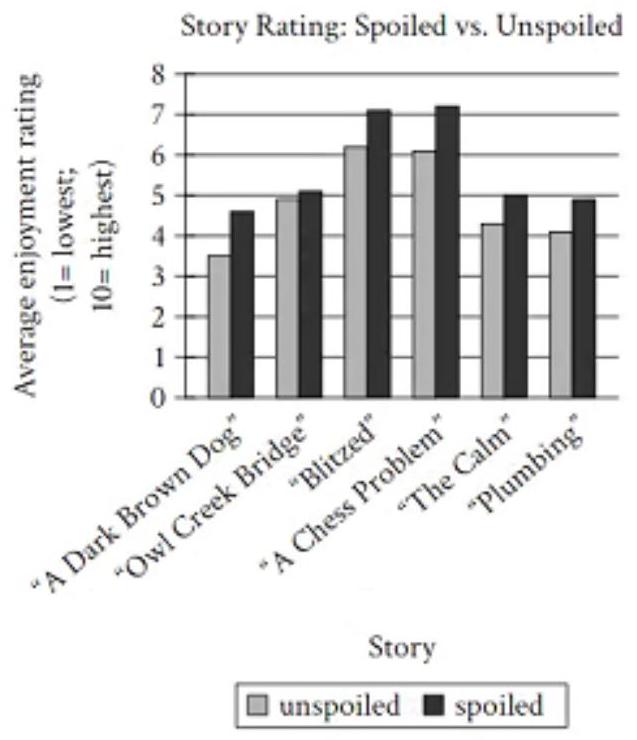
Researchers investigated how enjoyment of a story is affected when it has been spoiled (when the reader has foreknowledge of an important plot development). As part of the study, participants rated their enjoyment of one story that was spoiled before they read it and one story that was unspoiled. For each story, participants who had been given a spoiler reported greater enjoyment than did those who hadn't received a spoiler. But the degree of this difference varied across the stories, as is best illustrated by the enjoyment ratings for ______
Which choice most effectively uses data from the graph to complete the statement?
A) "Blitzed" and "Plumbing."
B) "Owl Creek Bridge" and "A Chess Problem."
C) "Blitzed" and "A Chess Problem."
D) "The Calm" and "Plumbing."
Think: To show that the "degree of difference varied," you need to compare stories with VERY DIFFERENT spoiler effects—one with a tiny gap, one with a huge gap.
Practice 4: Hawaii Tech Employment (Medium)
Type: Text + Data (Lookup & Complete)
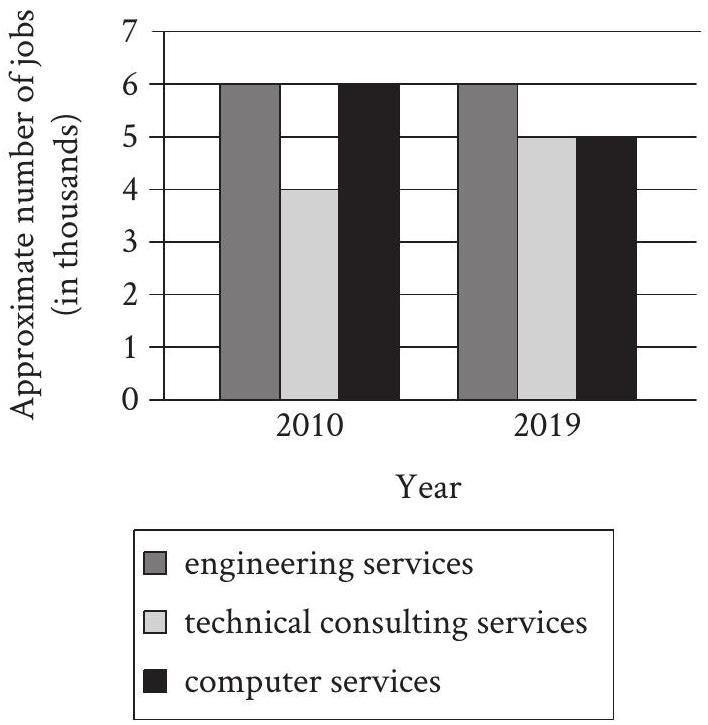
A student in Hawaii is interested in pursuing a career in technology and decides to do some research on local trends. The student notices that the number of jobs in computer services in 2010 was ______
Which choice most effectively uses data from the graph to complete the statement?
A) higher than the number of jobs in technical consulting services, and in 2019 was about the same as the number of jobs in engineering services.
B) about the same as the number of jobs in engineering services, and in 2019 was about the same as the number of jobs in technical consulting services.
C) lower than the number of jobs in engineering services, but in 2019 was higher than the number of jobs in engineering services.
D) about the same as the number of jobs in technical consulting services, but in 2019 was lower than the number of jobs in technical consulting services.
Think: The statement has TWO parts (2010 comparison AND 2019 comparison). Check BOTH against the graph.
Practice 5: Agricultural Trade Reform (Medium-Hard)
Type: Text + Data (Support/Weaken)
Table: Percent Change in Average Global Market Prices by Commodity in Two Agricultural Trade-Reform Scenarios
| Commodity | Percent change in TFA scenario | Percent change in tariff-removal scenario |
|---|---|---|
| Fruits and vegetables | -1.50 | +0.04 |
| Processed foods | -1.76 | -1.00 |
| Rice | -0.37 | +1.36 |
| Wheat | -1.35 | +0.45 |
Ratified in 2017 by two-thirds of World Trade Organization member nations, the Trade Facilitation Agreement (TFA) is a trade-reform measure that aims to reduce redundant customs procedures and other costly aspects of international trade. In a 2021 report, economist Jayson Beckman modeled global market prices of several agricultural commodities under both the TFA and an alternative trade-reform scenario: removal of agricultural tariffs (taxes on imports that generally increase prices on imported goods). After reviewing data from the report, a student concludes that overall, consumers of the commodities listed in the table would likely benefit more from the TFA than they would from tariff removal.
Which choice most effectively uses data from the table to support the student's claim?
A) Under the tariff-removal scenario, the average prices of processed foods, wheat, and fruits and vegetables would decrease by more than 1%, while the average price of rice would decrease by less than 1%.
B) Under the tariff-removal scenario, the average price of processed foods would increase, but the average prices of wheat and rice would decrease.
C) Under the TFA scenario, the average prices of all four commodities would decrease, whereas under the tariff-removal scenario, only the average price of processed foods would decrease.
D) Under the TFA scenario, the average price of rice would decrease by a smaller amount than any of the other three commodities' prices would, whereas its average price would increase under the tariff-removal scenario.
Think: What benefits consumers? Remember: answers can be factually incorrect—check them against the actual data!
Practice 6: Magical Realism (Hard)
Type: Text Only (Illustrate with Quote)
Scholars cite Men of Maize as foundational to magical realism, which juxtaposes "antirealistic plot devices—often borrowed from folkloric traditions" with "otherwise realistic" representation. This influenced Pamuk, whose My Name Is Red "resembles classic magical realist novels in its juxtaposition of literary realism with folklore."
Which quotation from a literary critic best supports the underlined claim?
A) "My Name Is Red clearly shows the influence of Latin American magical realism and Turkish folklore traditions."
B) "The realistic plot of My Name Is Red is repeatedly and productively disrupted by imagery and situations borrowed from Turkish folklore."
C) "My Name Is Red is indebted to the antirealistic elements found in Turkish folklore, much as Latin American magical realism drew from indigenous traditions."
D) "My Name Is Red alternates between realistic and antirealistic narrative modes, with Turkish folklore appearing throughout."
Think: What's the difference between asserting something and illustrating it?
Practice 7: Candidate Likability (Hard)
Type: Text + Data (Support/Weaken)
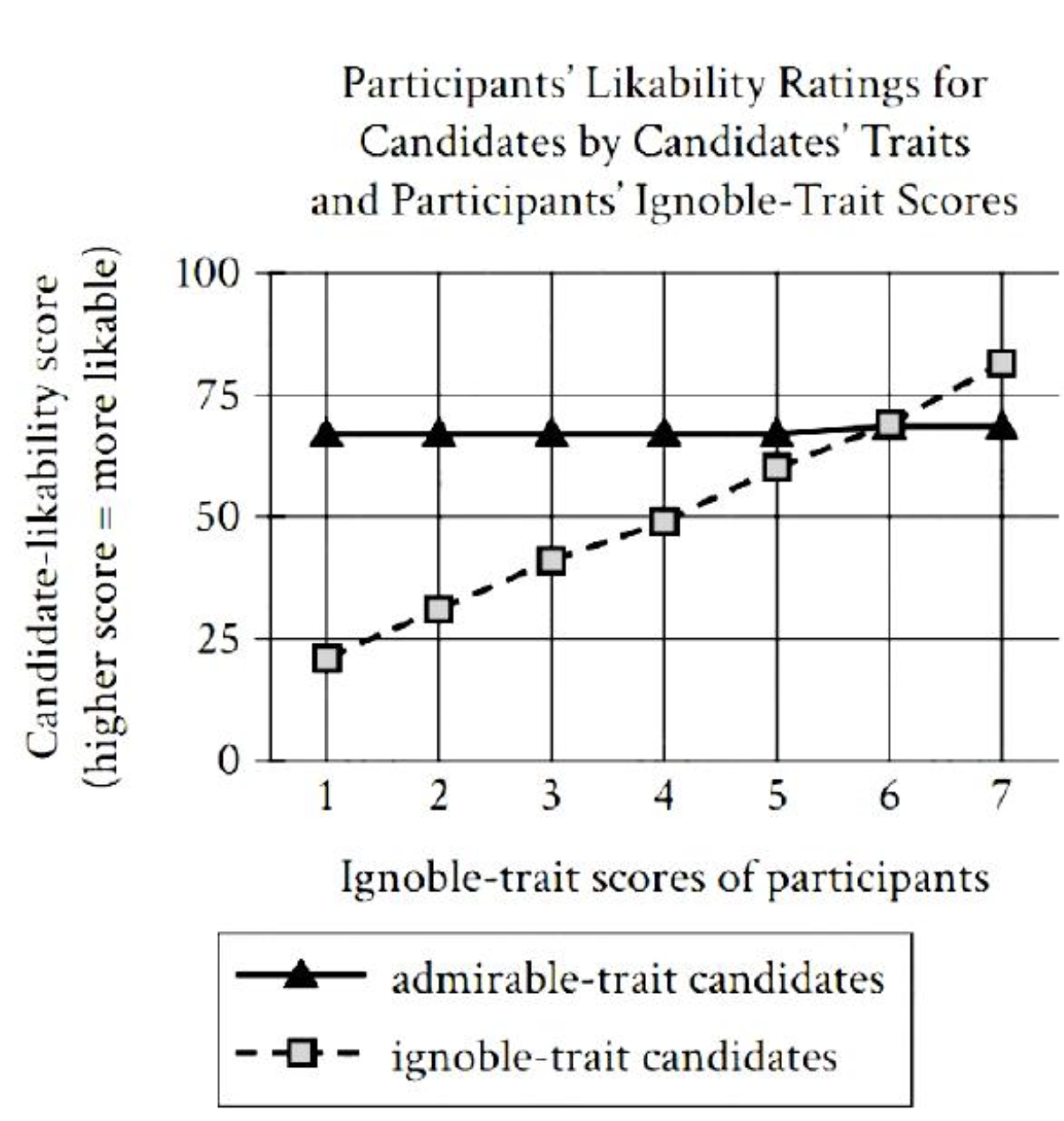
Alessandro Nai et al. presented study participants with vignettes about fictive political candidates, portraying them as embodying a personality trait widely considered admirable (e.g., agreeableness) or one considered ignoble (e.g., cynicism). A survey recorded participants' ratings of the candidates' likability and showed that across participants, ignoble-trait candidates were less likable than admirable-trait candidates. However, when the researchers factored in the participants' own personality trait scores, on a scale of 1 (least ignoble) to 7 (most ignoble), they concluded that this relative ranking of candidates persisted except among the participants with high ignobility scores.
Which choice best describes data from the graph that support the researchers' conclusion?
A) Overall, participants rated admirable-trait candidates as quite likable, and that rating was not significantly affected by the participants' ignobility scores.
B) Participants with an ignobility score of 5 or less rated admirable-trait candidates as more likable than ignoble-trait candidates, whereas participants with an ignobility score of 6 or more rated ignoble-trait candidates as equally likable as or even more likable than admirable-trait candidates.
C) Unlike participants with an ignobility score of 6, participants with an ignobility score either greater or less than 6 gave admirable-trait candidates and ignoble-trait candidates different likability ratings.
D) There was a strong positive correlation between participants' ignobility scores and admirable-trait candidates' likability ratings, but there was no correlation between participants' ignobility scores and ignoble-trait candidates' likability ratings.
Think: The conclusion has two parts: (1) ignoble candidates were generally rated lower, (2) EXCEPT among high-ignobility participants. Which answer captures BOTH parts?
Practice Answers
Click to reveal answers
Practice 1: D (Trophic Cascade) The hypothesis is a causal chain: sharks ↓ → rays ↑ → oysters ↓. Answer D confirms the first link: "rays have increased as sharks have decreased." This supports the hypothesis.
Trap - Answer C: Says rays were eating more oysters BEFORE sharks declined. If rays increased before the supposed cause (shark decline), that WEAKENS the hypothesis—the shark decline isn't the cause.
Practice 2: C (Whale Size) The claim is that smaller size is an "adaptation to distinct resource opportunities." To support this, we need evidence that smaller size provides a resource ADVANTAGE. Answer C shows PCFG whales can access "shallow depths inaccessible to whales as large as those in the ENP main group"—smaller size → access to resources.
Trap - Answer B: Shows different prey availability but doesn't explain WHY smaller size helps. Different prey ≠ size advantage.
Practice 3: B (Spoiled Stories) The statement says "the degree of this difference varied across the stories." To best illustrate this variation, we need to compare stories with the most different spoiler effects—one showing minimal difference between spoiled/unspoiled ratings, one showing maximum difference.
Looking at the graph: - "Owl Creek Bridge" shows the smallest spoiler effect (~0.1 point difference) - "A Chess Problem" shows the largest spoiler effect (~1.1 point difference)
- A pairs "Blitzed" (~0.8 difference) with "Plumbing" (~0.8 difference)—both moderate effects, doesn't show variation.
- B pairs the extremes: "Owl Creek Bridge" (smallest gap) with "A Chess Problem" (largest gap). This best illustrates how much the effect varied. ✓
Practice 4: B (Hawaii Tech Employment) The statement has two parts—check BOTH against the graph data:
In 2010: Computer services (6,000) was about the same as engineering services (6,000). ✓ In 2019: Computer services (5,000) was about the same as technical consulting services (5,000). ✓
- A says computer services was HIGHER than technical consulting in 2010 (6,000 vs 4,000 is higher, not "about the same")—but then says 2019 was about the same as engineering (5,000 vs 6,000 isn't quite the same). Doesn't match.
- B matches both parts: 2010 computer ≈ engineering, 2019 computer ≈ technical consulting. ✓
- C says computer services was LOWER than engineering in 2010—but they were equal (both 6,000). First part is wrong.
- D says 2019 computer services was LOWER than technical consulting—but they were equal (both 5,000). Second part is wrong.
Practice 5: C (Agricultural Trade Reform) The claim is that consumers benefit more from TFA than tariff removal. Lower prices = benefit to consumers. Let's check each answer against the data:
- A is factually incorrect. Under tariff-removal: fruits/veg +0.04% (increase, not decrease), wheat +0.45% (increase), rice +1.36% (increase). This answer misstates the data.
- B is factually incorrect. Under tariff-removal: processed foods -1.00% (decrease, not increase), wheat +0.45% (increase, not decrease), rice +1.36% (increase, not decrease). Almost entirely wrong.
- C is correct. TFA: all four decrease (✓). Tariff-removal: only processed foods decreases (-1.00%), while the other three increase (✓). This supports "consumers benefit more from TFA."
- D is true but doesn't support the claim. It just describes rice's behavior—doesn't compare overall consumer benefit between scenarios.
Practice 6: B (Magical Realism) The claim is about "juxtaposition of literary realism with folklore." Required elements: (1) realism, (2) folklore, (3) juxtaposition (interaction between them).
Answer B: "realistic plot" + "disrupted by imagery from Turkish folklore" = shows the juxtaposition IN ACTION.
Trap - Answer A: Just STATES there's influence from both—doesn't SHOW the juxtaposition. Trap - Answer D: "Alternates" ≠ "juxtaposition." Alternating suggests switching back and forth; juxtaposition means putting things together so they interact. "Disrupted by" captures this better.
Practice 7: B (Candidate Likability) The researchers' conclusion has two parts: (1) ignoble-trait candidates were generally rated lower than admirable-trait candidates, and (2) this pattern did NOT hold for participants with high ignobility scores. The correct answer must support BOTH parts.
Looking at the graph: - For participants with ignobility scores 1-5, the solid line (admirable-trait) is clearly above the dashed line (ignoble-trait) → admirable candidates rated higher - For participants with ignobility scores 6-7, the lines converge or cross → ignoble candidates rated similarly or higher
- A only addresses admirable-trait candidates and says nothing about the exception for high-ignobility participants.
- B captures both parts: scores ≤5 show admirable > ignoble, scores ≥6 show ignoble ≥ admirable. This is exactly what the graph shows and supports the full conclusion. ✓
- C focuses oddly on "score of 6" as a pivot point but describes the pattern incorrectly.
- D reverses the correlation—the graph shows ignoble-trait ratings increase with ignobility scores (positive correlation), not admirable-trait ratings.
Inference
These questions ask you to "logically complete the text." You'll recognize them by the prompt: "Which choice most logically completes the text?"
This is the ONLY question type with this prompt—so identification is easy.
What They Look Like
Geoglyphs are large-scale designs of lines or shapes created in a natural landscape. The Nazca Lines were created in the Nazca Desert in Peru by several Indigenous civilizations over a period of many centuries. Peruvian archaeologist Johny Isla specializes in these geoglyphs. At a German exhibit about the Nazca Lines, he saw an old photograph of a large geoglyph of a whalelike figure and was surprised that he didn't recognize it. Isla returned to Peru and used a drone to search a wide area, looking for the figure from the air. This approach suggests that Isla thought that if he hadn't already seen it, the whalelike geoglyph ______
Which choice most logically completes the text?
A) must represent a species of whale that went extinct before there were any people in Peru.
B) is actually located in Germany, not Peru, and isn't part of the Nazca Lines at all.
C) is probably in a location Isla hadn't ever come across while on the ground.
D) was almost certainly created a long time after the other Nazca Lines geoglyphs were created.
What to Know
Key Insight
These are called "Inference" questions, but don't let the name mislead you. You're not making big logical leaps or reading between the lines.
The correct answer is the smallest logical step from the evidence.
Think of it this way: the SAT can't ask you to guess or speculate—they need one defensible answer. So the "inference" is really just a conclusion that can be safely deduced from what the passage states. If you find yourself thinking "well, this COULD be true..." you're probably going too far.
Stay rooted in the text. The answer that feels almost obvious—boringly close to what the passage says—is usually right.
The General Approach
Step 1: Read the question, then read the text.
Step 2: As you read, turn the text into a series of bullet points in your head: - Point A - Point B - Point C...
Step 3: Before looking at answers, ask: "Therefore, what?" (sometimes you will be able to predict an answer)
Step 4: Use process of elimination until you're down to one answer.
Watch Out For:
-
Out of scope — Introduces ideas not in the passage.
-
Reverse direction — Flips causation or movement.
-
Overconclude — Goes further than the evidence supports.
Remember, the correct answer is the smallest logical step from the evidence.
Common Patterns
While every Inference question is unique, certain patterns show up repeatedly:
| Pattern | What You'll See | Strategy |
|---|---|---|
| Evidence → Conclusion | "Researchers found X... This suggests that ______" | List the key evidence. Ask: "What does this PROVE?" |
| Synthesizing Multiple Findings | Two studies or facts, often in tension. "Taken together, these results suggest ______" | Find the ONE explanation that accounts for BOTH findings |
| Old Belief → New Evidence | "It was long thought that X..." then new evidence contradicts | Find the old belief, find the new evidence, pick the answer that revises the belief |
Examples
Example: Vinland Map
When the Vinland Map, a map of the world purported to date to the mid-1400s, surfaced in 1957, some scholars believed it demonstrated that European knowledge of the eastern coast of present-day North America predated Christopher Columbus's 1492 arrival. In 2021, a team including conservators Marie-France Lemay and Paula Zyats and materials scientist Anikó Bezur performed an extensive analysis of the map and the ink used. They found that the ink contains titanium dioxide, a compound that was first introduced in ink manufacturing in the early 1900s. Therefore, the team concluded that ______
Which choice most logically completes the text?
STOP — Try this yourself first. The map claims to be from the mid-1400s. The ink wasn't available until the 1900s. What must be true?
Solution
Build the chain:
- IF the map is from the 1400s
- AND the ink contains a compound from the 1900s
- THEN the map can't actually be from the 1400s
| Answer | Verdict |
|---|---|
| A) Europeans couldn't have known about North America before Columbus | Goes too far—the map being fake doesn't disprove the knowledge |
| B) The map couldn't have been drawn by mid-1400s mapmakers | Directly follows from the evidence |
| C) Mapmakers must have used titanium in the 1400s | Contradicts what the passage says |
| D) Not enough info to determine when ink was created | They DID determine it—early 1900s |
Answer: B
Example: Stock Market Liberalization
In June of 1987, South Korea liberalized its stock market... Ross Levine and Sara Zervos found that liberalization did not lead to enduring increases in investment... Peter Blair Henry, however, found that, on average, investment in companies in liberalized countries increased significantly in the three years following liberalization. Taken together, these results suggest that ______
Which choice most logically completes the text?
A) investment growth is likely to be more consistent in countries that liberalize than in countries that do not.
B) companies typically do not benefit from liberalization until at least three years after liberalization occurs.
C) liberalization may provide a boost to investment that fades over time.
D) economists' expectations about the effect of liberalization on investment were largely correct.
STOP — Try this yourself first. Map each finding. What's the ONE explanation that accounts for BOTH?
Solution
Map the findings: - Levine/Zervos: No ENDURING increase (long-term: flat) - Henry: Significant increase in first 3 YEARS (short-term: up)
How can both be true? Short-term boost + no long-term effect = boost that fades.
| Answer | Verdict |
|---|---|
| A) More consistent growth | Neither study discusses "consistency" |
| B) Don't benefit until after 3 years | Misreads Henry—he found benefits IN the first three years, not AFTER |
| C) Boost that fades over time | Captures both: short-term boost (Henry) + no lasting effect (Levine/Zervos) |
| D) Expectations were correct | Vague—doesn't synthesize the specific findings |
Answer: C
Note: When a question says "taken together, these results suggest," the correct answer must account for BOTH findings—not just one. Answer B only addresses Henry's finding (and misreads it). Answer C is the only choice that explains how both studies can be true simultaneously: there's a short-term boost (Henry) that doesn't last (Levine/Zervos).
Example: Venusian Whistler Waves
Whistler waves are low-frequency plasma waves that on Earth are typically generated by lightning. Numerous recordings of whistler waves on Venus have led many scientists to suggest that the planet's atmosphere is host to extensive amounts of lightning, and, in fact, Venusian whistler waves have similar energy signatures to those of whistler waves generated by lightning on Earth. The majority of Venusian whistler wave data come from two spacecraft missions—the Pioneer Venus Orbiter (PVO) and the Venus Express (VEX)—which have included few observations of other phenomena consistent with lightning occurrences (such as flashes of light), leading other scientists to suggest that ______
Which choice most logically completes the text?
A) there are geophysical characteristics of Venus not shared with Earth that promote the generation of whistler waves.
B) the purported Venusian whistler waves must actually be some other type of atmospheric activity than whistler waves.
C) Venusian lightning has properties that make it unlikely to generate whistler waves.
D) similarities in the energy signatures of Venusian and Earth whistler waves may reflect imprecisions in the PVO and VEX data.
STOP — Try this yourself first. What do some scientists believe? What makes other scientists skeptical?
Solution
Find the competing views: - Group 1: Whistler waves on Venus = lightning (same as Earth) - Group 2: But we don't see other signs of lightning (no light flashes)
What would explain whistler waves WITHOUT lightning? Something else on Venus must be causing them.
The reasoning chain: - On Earth, whistler waves come from lightning - Venus has whistler waves (confirmed by similar energy signatures) - But Venus shows no other signs of lightning (no light flashes) - Therefore: either Venus has invisible lightning, OR something else causes the waves - "Other scientists suggest" points toward the second option
| Answer | Verdict |
|---|---|
| A) Geophysical characteristics of Venus cause whistler waves | ✓ Explains how Venus could have whistler waves without lightning—something unique to Venus generates them |
| B) Not actually whistler waves | Contradicts the passage—they DO have similar energy signatures to Earth's whistler waves |
| C) Venusian lightning doesn't generate whistler waves | Backwards—the question is whether there's lightning at all, not whether lightning would make waves |
| D) Data imprecision | Doesn't address the lack of light flashes; this would question the wave data, not explain the missing lightning evidence |
Answer: A
Practice
Practice 1 (Easy)
In 2019, marine biologist Erin Burge observed that sea otters in Monterey Bay were using rocks as tools to crack open shellfish. This behavior had been documented before, but Burge noticed something new: the otters were returning to the same rocks repeatedly, sometimes swimming considerable distances to retrieve a favorite tool rather than picking up a closer rock. This suggests that ______
Which choice most logically completes the text?
A) sea otters prefer to eat shellfish that can only be opened with specific types of rocks.
B) sea otters may form attachments to particular tools rather than treating all rocks as interchangeable.
C) the rocks in Monterey Bay are better suited for cracking shellfish than rocks in other locations.
D) sea otters' tool use has become more sophisticated over time due to environmental pressures.
Think: What's unusual about the otters' behavior? What does going out of their way for a specific rock suggest?
Practice 2 (Easy-Medium)
Stellate barnacles (Chthamalus stellatus) are small marine crustaceans known to attach themselves firmly to fixed structures such as rocks and piers. Long thought to be sessile—that is, unable to self-locomote—these animals were recently observed by researchers in Spain moving along rock surfaces without the assistance of water currents or other outside forces. The researchers therefore suggest that ______
Which choice most logically completes the text?
A) C. stellatus is more closely related to other marine crustaceans that are known to self-locomote than was previously assumed.
B) C. stellatus may be able to move under its own power despite being thought to lack this ability.
C) many animals previously thought to be sessile, including numerous other species of barnacle, are likely able to self-locomote.
D) the rock surfaces where C. stellatus was observed moving are especially conducive to the movement of marine animals.
Think: What was the old belief? What does the new observation suggest?
Practice 3 (Medium)
Some businesses believe that when employees are interrupted while doing their work, they experience a decrease in energy and productivity. However, a team led by Harshad Puranik, who studies management, has found that interruptions by colleagues can have a social component that increases employees' sense of belonging, resulting in greater job satisfaction that benefits employees and employers. Therefore, businesses should recognize that ______
Which choice most logically completes the text?
A) the interpersonal benefits of some interruptions in the workplace may offset the perceived negative effects.
B) in order to maximize productivity, employers should be willing to interrupt employees frequently throughout the day.
C) most employees avoid interrupting colleagues because they don't appreciate being interrupted themselves.
D) in order to cultivate an ideal workplace environment, interruptions of work should be discouraged.
Think: What's the relationship between the two views? What conclusion reconciles them?
Practice 4 (Medium)
Aerogels are highly porous foams consisting mainly of tiny air pockets within a solidified gel. These lightweight materials are often applied to spacecraft and other equipment required to withstand extreme conditions, as they provide excellent insulation despite typically being brittle and eventually fracturing due to degradation from repeated exposure to high heat. Now, Xiangfeng Duan of the University of California, Los Angeles, and colleagues have developed an aerogel with uniquely flexible properties. Unlike earlier aerogels, Duan's team's material contracts rather than expands when heated and fully recovers after compressing to just 5% of its original volume, suggesting that ______
Which choice most logically completes the text?
A) the aerogel's remarkable flexibility results from its higher proportion of air pockets to solidified gel as compared to other aerogels.
B) the aerogel's overall strength is greater than that of other insulators but its ability to withstand exposure to intense heat is lower.
C) the aerogel will be more effective as an insulator for uses that involve gradual temperature shifts than for those that involve rapid heat increases.
D) the aerogel will be less prone to the structural weakness that ultimately causes most other aerogels to break down with use.
Think: What problem do regular aerogels have? How does Duan's aerogel address it?
Practice 5 (Medium)
Ancestral Puebloans, who lived in the Mesa Verde region of what is now Colorado, had systems for farming crops and turkeys. When the region's Puebloans dispersed in the late 1200s C.E., they might have taken aspects of these systems with them to new areas. In a recent study, researchers analyzed the remains of turkeys that had been kept by Puebloans at Mesa Verde and at sites in the Rio Grande Valley of what is now New Mexico and found shared genetic markers appearing in the Rio Grande Valley only after 1280 C.E. Thus, researchers concluded that ______
Which choice most logically completes the text?
A) conditions of the terrains in the Rio Grande Valley and Mesa Verde had greater similarities in the past than they do today.
B) some Ancestral Puebloans migrated to the Rio Grande Valley in the late 1200s and carried farming practices with them.
C) Indigenous peoples living in the Rio Grande Valley primarily planted crops and did not cultivate turkeys before 1280.
D) the Ancestral Puebloans of Mesa Verde likely adopted the farming practices of Indigenous peoples living in other regions.
Think: What does the timing of the genetic markers prove? Watch the direction.
Practice 6 (Medium)
Researchers studying forest health have found that forests managed through controlled burns and selective logging often have higher tree density and greater species diversity than forests left unmanaged. This seems counterintuitive—removing trees should reduce their numbers, not increase them. But the researchers point out that in unmanaged forests, dead wood and dense undergrowth can fuel devastating wildfires that kill far more trees than controlled management would remove. These findings suggest that ______
Which choice most logically completes the text?
A) the definition of "forest health" should be revised to exclude measures of tree density.
B) selective logging is more effective than controlled burns at promoting forest health.
C) forests left entirely unmanaged may face greater long-term threats to tree populations than managed forests do.
D) wildfires in unmanaged forests rarely spread beyond the area where they originate.
Think: What's the paradox? How does the explanation resolve it?
Practice 7 (Medium-Hard)
Early studies of decision-making assumed that people evaluate options by calculating expected outcomes—weighing potential gains against potential losses. But behavioral economist Daniel Kahneman found that losses loom larger than equivalent gains: losing $100 feels roughly twice as painful as gaining $100 feels pleasurable. Subsequent research has shown that this "loss aversion" diminishes when people make decisions on behalf of others rather than themselves. Taken together, these findings suggest that ______
Which choice most logically completes the text?
A) people are generally more rational when making financial decisions for others than when making such decisions for themselves.
B) the psychological weight people assign to potential losses may depend on who will experience those losses.
C) early models of decision-making were fundamentally correct despite Kahneman's findings about loss aversion.
D) decisions made on behalf of others tend to result in worse financial outcomes than decisions made for oneself.
Think: What do both findings have in common? What variable affects how loss aversion works?
Practice 8 (Hard)
Gravitational wave astronomy, which detects ripples in spacetime caused by massive cosmic events, has enabled observations impossible with traditional light-based telescopes. In 2017, both gravitational waves and electromagnetic radiation were detected from a neutron star merger—the first time a single cosmic event was observed through both methods. While some astronomers celebrated this as validation that gravitational wave detection complements traditional astronomy, others noted that the gravitational wave signal was detected a full 1.7 seconds before the first light reached Earth, suggesting that ______
Which choice most logically completes the text?
A) electromagnetic radiation travels more slowly through space than gravitational waves do under certain conditions.
B) gravitational wave detectors may be able to provide advance warning of cosmic events before they become visible to light-based telescopes.
C) the neutron star merger produced gravitational waves and electromagnetic radiation at different points in the collision process.
D) traditional light-based telescopes will eventually be replaced entirely by gravitational wave detectors.
Think: What does the 1.7-second gap imply for future observations? Don't overconclude—pick the smallest logical step.
Practice Answers
Click to reveal answers
Practice 1: B (Sea Otters) The key observation: otters swim "considerable distances" to retrieve a specific rock rather than using a closer one. This suggests individual rocks have value to the otters beyond just being tools—they form attachments to particular rocks. Answer A is unsupported (nothing about shellfish types). C is irrelevant (comparing locations). D introduces "environmental pressures" not mentioned.
Practice 2: B (Barnacles) Old belief: barnacles are "sessile" (can't move on their own). New observation: they were "moving along rock surfaces without the assistance of water currents or other outside forces." The inference revises the old belief: they CAN move under their own power. Answer C expands too far (to "many animals" and "numerous species").
Practice 3: A (Interruptions) The passage presents two views: (1) interruptions hurt productivity, (2) interruptions can increase belonging and satisfaction. The conclusion should reconcile them—the benefits may "offset" the perceived negatives. Note that B goes too far ("frequently"), C introduces information not discussed, and D contradicts the research findings.
Practice 4: D (Aerogels) Regular aerogels are "brittle and eventually fracturing due to degradation from repeated exposure to high heat." Duan's aerogel "fully recovers after compressing"—it doesn't break down the same way. The inference: less prone to the structural weakness that breaks other aerogels.
Practice 5: B (Puebloans) The genetic markers appeared in Rio Grande Valley AFTER 1280, matching when Puebloans dispersed. Turkeys don't migrate on their own—people must have brought them. The direction: FROM Mesa Verde TO Rio Grande Valley. Answer D reverses the direction (says Mesa Verde adopted FROM other regions).
Practice 6: C (Forest Management) The paradox: Removing trees leads to MORE trees (counterintuitive). The resolution: unmanaged forests face devastating wildfires that kill more trees than management removes. The inference: unmanaged forests face greater threats. This explains how "removing trees" actually protects tree populations in the long run.
Practice 7: B (Loss Aversion) Two findings to synthesize: (1) losses feel worse than equivalent gains, (2) this effect diminishes when deciding for others. What accounts for both? The psychological weight of losses depends on WHO experiences them—self vs. others. Answer A overclaims ("more rational"). C contradicts the passage. D introduces outcomes not discussed.
Practice 8: B (Gravitational Waves) The key fact: gravitational waves arrived 1.7 seconds BEFORE light. The smallest logical step: this timing gap means gravitational wave detectors could warn us of events before telescopes see them. Answer A may be true but isn't the inference being drawn. C is a possible explanation but not what "suggests" points to. D overclaims ("replaced entirely").
Transitions
Transitions questions ask you to pick the word or phrase that best expresses the relationship between two sentences or ideas. You'll recognize them by the prompt: "Which choice completes the text with the most logical transition?"
What They Look Like
In 1885, Chinese-born California resident Mary Tape became a hero of the Asian American civil rights movement. In January of that year, she won an antidiscrimination case in the California Supreme Court. ______ in April, she wrote an open letter criticizing her local board of education for discrimination. Both actions are remembered today as historic stands against racism.
Which choice completes the text with the most logical transition?
A) Later,
B) For instance,
C) In other words,
D) Rather,
What to Know
Key Insight
You don't need to memorize individual transition words. You need to identify the RELATIONSHIP between the sentences.
The SAT doesn't care whether you pick "also" or "in addition"—those mean the same thing. What matters is recognizing that you need an addition word rather than a contrast word. Get the category right, and the answer becomes obvious.
The General Approach
Step 1: Read the question, then read the text.
Step 2: As you read, compare the sentence that the blank is in with the sentence before it—what's the relationship?
Step 3: Before looking at answers, predict the type of transition needed (contrast, cause-effect, continuation, example, etc.).
Step 4: Pick the answer that matches your predicted category. Plug it back in and re-read to confirm.
Transition Categories
| Category | When to Use | Common Words |
|---|---|---|
| Same Direction | Second idea adds to, continues, or parallels the first | also, moreover, furthermore, additionally, likewise, similarly |
| Left Turn | Second idea opposes, contradicts, or concedes | however, but, instead, by contrast, nevertheless, nonetheless, that said |
| Cause/Effect | Second idea is a result of the first | therefore, thus, consequently, as a result, hence, accordingly |
| Example | Second idea is a specific case of the first | for example, for instance, specifically, in particular |
| Confirmation | Second idea proves or emphasizes the first | indeed, in fact |
| Other | Time sequence, listing, summary | then, later, first/second/finally, in sum, in short |
Category Identification
For each transition word below, identify which category it belongs to: Same Direction, Left Turn, Cause/Effect, Example, Confirmation, or Other. If it doesn't fit neatly into one of these categories, describe what kind of relationship it suggests.
| 1. Therefore | 8. Furthermore | 15. That said | 22. In short |
| 2. Similarly | 9. Instead | 16. Likewise | 23. For example |
| 3. However | 10. Indeed | 17. Regardless | 24. As such |
| 4. Thus | 11. By contrast | 18. Consequently | 25. To that end |
| 5. Additionally | 12. Moreover | 19. In particular | 26. That is |
| 6. Still | 13. As a result | 20. Also | 27. For instance |
| 7. Since | 14. Hence | 21. Nevertheless | 28. Later |
Click to reveal answers
| # | Word | Category | |---|------|----------| | 1 | Therefore | Cause/Effect | | 2 | Similarly | Same Direction | | 3 | However | Left Turn | | 4 | Thus | Cause/Effect | | 5 | Additionally | Same Direction | | 6 | Still | Left Turn (concession) | | 7 | Since | Cause/Effect (introduces cause) | | 8 | Furthermore | Same Direction | | 9 | Instead | Left Turn | | 10 | Indeed | Confirmation | | 11 | By contrast | Left Turn | | 12 | Moreover | Same Direction | | 13 | As a result | Cause/Effect | | 14 | Hence | Cause/Effect | | 15 | That said | Left Turn (concession) | | 16 | Likewise | Same Direction | | 17 | Regardless | Left Turn (concession) | | 18 | Consequently | Cause/Effect | | 19 | In particular | Example | | 20 | Also | Same Direction or Other (time sequence) | | 21 | Nevertheless | Left Turn | | 22 | In short | Other (summary) | | 23 | For example | Example | | 24 | As such | Cause/Effect | | 25 | To that end | Other (purpose) | | 26 | That is | Other (clarification/restatement) | | 27 | For instance | Example | | 28 | Later | Other (time sequence) |Examples
Example 1: Same Direction
Mexico's Alondra de la Parra took over as conductor for the Queensland Symphony Orchestra in 2017, ______ and Colombia's Lina Gonzalez-Granados did the same for the Los Angeles Opera in 2022.
A) in addition,
B) lastly,
C) granted,
D) for instance,
STOP — Try this yourself first. Two conductors doing the same thing. What kind of relationship is this?
Solution
Step 1: Two conductors doing the same thing (taking over orchestras). Same direction—we need a word that adds or continues.
Step 2: Check the answers:
| Answer | Verdict |
|---|---|
| A) in addition | ✓ Adds another example of the same thing |
| B) lastly | ✗ Implies a sequence/list that doesn't exist |
| C) granted | ✗ Concession word—wrong direction |
| D) for instance | ✗ Would need a general statement before it |
Answer: A
Note: "For instance" (D) is tricky here. Both sentences ARE examples of the same phenomenon (conductors taking over orchestras). But "for instance" requires a general statement BEFORE it that the example illustrates. Here, the first sentence is itself a specific example, not a general claim. "In addition" works because it simply adds a second specific case to the first.
Example 2: Left Turn
At two weeks old, wolves can smell but cannot yet see or hear. Domesticated dogs, ______ can see, hear, and smell by the end of two weeks.
A) in other words,
B) for instance,
C) by contrast,
D) accordingly,
STOP — Try this yourself first. Wolves CAN'T see/hear at two weeks. Dogs CAN. Same or opposite?
Solution
Step 1: Wolves CAN'T see/hear at two weeks. Dogs CAN. Opposite situations = left turn.
Step 2: Check the answers:
| Answer | Verdict |
|---|---|
| A) in other words | ✗ Rephrasing—but these aren't the same idea |
| B) for instance | ✗ Example—but dogs aren't an example of wolves |
| C) by contrast | ✓ Signals opposition between wolves and dogs |
| D) accordingly | ✗ Cause/effect—but one doesn't cause the other |
Answer: C
Example 3: Other (Time Sequence)
In January of that year, she won an antidiscrimination case in the California Supreme Court. ______ in April, she wrote an open letter criticizing her local board of education.
A) Later,
B) For instance,
C) In other words,
D) Rather,
STOP — Try this yourself first. January → April. What kind of relationship is this?
Solution
Step 1: January → April. Two events in chronological order = time sequence.
Step 2: Check the answers:
| Answer | Verdict |
|---|---|
| A) Later | ✓ Signals time progression |
| B) For instance | ✗ The letter isn't an example of the court case |
| C) In other words | ✗ The letter isn't a restatement of the case |
| D) Rather | ✗ Implies correction—but nothing is being corrected |
Answer: A
Example 4: Confirmation (Indeed/In Fact)
With her installation The Interstitium, Laleh Mehran succeeded in creating a space that felt both "familiar and distant." ______ with a video screen at the far end of the coal slag-encrusted room, her installation was reminiscent of a typical movie theater—albeit one found in a subterranean coal mine.
A) Next,
B) Nevertheless,
C) Indeed,
D) Instead,
STOP — Try this yourself first. The first sentence makes a claim. Does the second sentence contradict, continue, or prove that claim?
Solution
Step 1: The first sentence claims the space felt "familiar and distant." The second sentence PROVES this claim—familiar (movie theater) and distant (coal mine). This is confirmation.
Step 2: Check the answers:
| Answer | Verdict |
|---|---|
| A) Next | ✗ Implies sequence—but this isn't a list of steps |
| B) Nevertheless | ✗ Concession—but nothing is being conceded |
| C) Indeed | ✓ Confirms/proves the previous claim |
| D) Instead | ✗ Replacement—but nothing is being replaced |
Answer: C
"Indeed" signals: "Yes, and here's the proof..."
Practice
Practice 1 (Easy)
Laetitia Ky's hair is her art. Inspired by hairstyles from various African tribes, the Ivorian artist uses wire and thread to sculpt her hair into all kinds of shapes. ______ she once made her hair into the shape of the continent of Africa—including the island of Madagascar!
A) Soon,
B) Elsewhere,
C) For example,
D) However,
Think: What's the relationship between "all kinds of shapes" and the Africa shape?
Practice 2 (Easy)
Phytoplankton play a crucial role in the ocean's uptake of carbon from the atmosphere. When alive, these tiny marine organisms absorb atmospheric carbon via photosynthesis. ______ after they die, the phytoplankton sink to the seafloor, where the carbon in their cells gets stored in sediment.
A) Specifically,
B) By contrast,
C) Nevertheless,
D) Then,
Think: What happens first? What happens next?
Practice 3 (Easy-Medium)
To discover which fruit varieties were grown in Italy's Umbria region before industrial farming, botanist Isabella Dalla Ragione often turns to centuries-old lists of cooking ingredients. ______ she analyzes Renaissance paintings of Umbria, as they can provide accurate representations of fruits grown there long ago.
A) In sum,
B) Instead,
C) Thus,
D) Additionally,
Think: Are these two different methods, or is one replacing the other?
Practice 4 (Medium)
"Wishcycling"—putting nonrecyclable items into recycling bins under the mistaken belief that those items can be recycled—ultimately does more harm than good. Nonrecyclable items can contaminate recyclable materials, rendering entire batches unusable. ______ nonrecyclable products can damage recycling plants' machinery.
A) Fittingly,
B) On the contrary,
C) Moreover,
D) Nevertheless,
Think: Is the second harm in addition to the first, or contrasting with it?
Practice 5 (Medium)
Originally coined by economist Joan Robinson to refer to markets with multiple sellers but only one buyer, the term "monopsony" can also refer to markets where demand for labor is limited. In a product monopsony, the single buyer can force sellers to lower their prices. ______ in a labor monopsony, employers can force workers to accept lower wages.
A) Earlier,
B) Instead,
C) Similarly,
D) In particular,
Think: Do these two types of monopsony work the same way or differently?
Practice 6 (Medium)
In studying whether jellyfish sleep, researchers attempted to answer three questions. ______ is there a period each day when the pulse rates of jellyfish decline? Second, do jellyfish respond more slowly to stimuli during that period? Finally, if prevented from sleeping, are jellyfish adversely affected?
A) As a result,
B) First,
C) Additionally,
D) However,
Think: What word would introduce the first item in a list of three?
Practice Answers
Click to reveal answers
Practice 1: C) For example, The Africa shape is a SPECIFIC EXAMPLE of "all kinds of shapes."
Practice 2: D) Then, TIME sequence: first alive (absorb carbon) → THEN dead (sink to seafloor).
Practice 3: D) Additionally, TWO different methods she uses—lists AND paintings. Addition.
Practice 4: C) Moreover, ADDITIONAL harm on top of contamination. Same direction = addition.
Practice 5: C) Similarly, Both types work the same way—the powerful party forces the weaker party to accept less. Parallel structure = addition/similarity.
Practice 6: B) First, Enumeration—First, Second, Finally. "First" introduces the first item.
Rhetorical Synthesis
These questions give you bullet-point notes and ask you to use them to accomplish a specific goal. You'll recognize them by the format: a set of notes followed by a prompt that describes what the answer should do.
These always appear at the very end of each Reading & Writing module.
What They Look Like
While researching a topic, a student has taken the following notes:
J.R.R. Tolkien's 1937 novel The Hobbit features two maps.
The novel opens with a reproduction of the map that the characters use on their quest.
This map introduces readers to the fictional world they are about to enter.
The novel closes with a map depicting every stop on the characters' journey.
That map allows readers to reconstruct the story they have just read.
The student wants to contrast the purposes of the two maps in The Hobbit. Which choice most effectively uses relevant information from the notes to accomplish this goal?
A) The Hobbit's opening map introduces readers to the fictional world they are about to enter, while the closing map allows them to reconstruct the story they have just read.
B) The Hobbit, a novel published by J.R.R. Tolkien in 1937, features a reproduction of a map that the characters use on their quest, as well as a map that appears at the end of the novel.
C) The Hobbit's two maps, one opening and one closing the novel, each serve a purpose for readers.
D) In 1937, author J.R.R. Tolkien published The Hobbit, a novel featuring both an opening and a closing map.
What to Know
Key Insight
The goal tells you EXACTLY what the answer must do. Every word matters.
The difference between "emphasize a similarity" and "emphasize the size" completely changes which answer is correct. Read the goal carefully—underline the action word and the specific focus.
Most students lose points here not because they can't find information in the notes, but because they don't precisely match what the goal requires.
The General Approach
Step 1: Read the question—specifically the GOAL. Skip the notes for now.
Step 2: Break the goal into parts. What are you being asked to do?
Step 3: Use process of elimination until you're down to one answer. (If stuck, now read the notes to fact-check.)
Watch Out For:
- Only hitting one requirement. If the goal says "present X to an audience unfamiliar with Y," the answer must both present X AND explain Y.
- Answering for the wrong audience. "Unfamiliar" audiences need explanations; "familiar" audiences don't. Read the audience part carefully.
- Confusing generalization with example. Specific names = example. Category language ("researchers typically") = generalization.
- What instead of how/why. "Describe the aim" ≠ "present the findings" ≠ "describe the method." Match the exact action word in the goal.
Examples
Example 1: Emphasize a Difference
While researching a topic, a student has taken the following notes:
Baking soda and baking powder are both chemical leavening agents used in baking.
Both cause carbon dioxide to be released within a batter when mixed with other ingredients.
Baking soda is pure sodium bicarbonate and must be combined with an acidic ingredient to produce carbon dioxide.
Baking powder contains sodium bicarbonate plus an acidic ingredient.
Baking powder does not need to be combined with an additional acidic ingredient to produce carbon dioxide.
The student wants to emphasize a difference between baking soda and baking powder. Which choice most effectively uses relevant information from the notes to accomplish this goal?
A) To make batters rise, bakers use chemical leavening agents such as baking soda and baking powder.
B) Baking soda and baking powder are chemical leavening agents that, when mixed with other ingredients, cause carbon dioxide to be released within a batter.
C) Baking soda is pure sodium bicarbonate, and honey is a type of acidic ingredient.
D) To produce carbon dioxide within a liquid batter, baking soda needs to be mixed with an acidic ingredient, whereas baking powder does not.
STOP — Try this yourself first. The goal is to emphasize a DIFFERENCE. What would that require in an answer?
Solution
Step 1 – Read the goal: "Emphasize a DIFFERENCE between baking soda and baking powder."
Step 2 – Break it into requirements: 1. Both items must be named 2. Must use contrast language (whereas, while, unlike, etc.) 3. Must state what's actually different
Step 3 – Check answers against requirements:
| Answer | Verdict |
|---|---|
| A) Both named, but describes what they have IN COMMON | ✗ No difference shown |
| B) Both named, but again describes SIMILARITY | ✗ No contrast |
| C) Only discusses baking soda | ✗ Doesn't compare |
| D) Both named + "whereas" (contrast) + states the difference | ✓ Meets all requirements |
Answer: D
(I didn't need to read the notes—the goal requirements alone eliminated A, B, and C.)
Example 2: Unfamiliar Audience
While researching a topic, a student has taken the following notes:
The Haudenosaunee Confederacy is a group of six Native nations in the northeastern United States.
The Great Law of Peace is a set of principles that has guided the Haudenosaunee Confederacy for centuries.
The influence theory holds that the Great Law of Peace influenced the US Constitution.
Historian Bruce Johansen supports this theory.
Benjamin Franklin and Thomas Jefferson both studied the Haudenosaunee Confederacy.
The student wants to present the influence theory to an audience unfamiliar with the Haudenosaunee Confederacy. Which choice most effectively uses relevant information from the notes to accomplish this goal?
A) Historian Bruce Johansen believes that the Great Law of Peace was very influential.
B) The influence theory is supported by the fact that Benjamin Franklin and Thomas Jefferson both studied the Haudenosaunee Confederacy.
C) The influence theory holds that the principles of the Great Law of Peace, a centuries-old agreement binding six Native nations in the northeastern US, influenced the US Constitution.
D) Native people, including the members of the Haudenosaunee Confederacy, influenced the founding of the US in many different ways.
STOP — Try this yourself first. The audience is UNFAMILIAR. What information would they need?
Solution
Step 1 – Read the goal: "Present the influence theory to an audience UNFAMILIAR with the Haudenosaunee Confederacy."
Step 2 – Break it into requirements: 1. Must explain what the influence theory IS 2. Since audience is unfamiliar, must explain/define what the Haudenosaunee Confederacy is
Step 3 – Check answers against requirements:
| Answer | Verdict |
|---|---|
| A) Too vague—doesn't explain what was influenced | ✗ Fails requirement #1 |
| B) Assumes audience knows what the Confederacy is | ✗ Fails requirement #2 |
| C) Explains the theory + defines it for unfamiliar audience | ✓ Meets both requirements |
| D) Too vague—doesn't present the specific theory | ✗ Fails requirement #1 |
Answer: C
(Again, I matched goal requirements to answers without needing to study the notes.)
Example 3: Emphasize a Similarity
While researching a topic, a student has taken the following notes:
The magnificent frigatebird is a large seabird.
It has two ways of acquiring food.
In one method, it uses its hook-tipped bill to snatch prey from the water's surface.
In the other method, called kleptoparasitism, it takes food from other birds by force.
Neither method requires the frigatebird to dive into the water.
The student wants to emphasize a similarity between the two ways a magnificent frigatebird acquires food. Which choice most effectively uses relevant information from the notes to accomplish this goal?
A) A magnificent frigatebird never dives into the water, instead using its hook-tipped bill to snatch prey from the surface.
B) Neither of a magnificent frigatebird's two ways of acquiring food requires the bird to dive into the water.
C) Of the magnificent frigatebird's two ways of acquiring food, only one is known as kleptoparasitism.
D) In addition to snatching prey from the water with its hook-tipped bill, a magnificent frigatebird takes food from other birds by force.
STOP — Try this yourself first. The goal is to emphasize a SIMILARITY. What would that require?
Solution
Step 1 – Read the goal: "Emphasize a SIMILARITY between the two ways."
Step 2 – Break it into requirements: 1. Must reference BOTH methods 2. Must use similarity language (both, neither, similarly, etc.) 3. Must state what they have IN COMMON
Step 3 – Check answers against requirements:
| Answer | Verdict |
|---|---|
| A) Only discusses ONE method | ✗ Can't show similarity with one thing |
| B) References both + "neither" + states what's common | ✓ Meets all requirements |
| C) Emphasizes a DIFFERENCE ("only one") | ✗ Wrong direction |
| D) Lists both methods but no commonality stated | ✗ Missing requirement #3 |
Answer: B
(Goal requirements alone got me to the answer.)
Note: Answer D is a subtle trap. It mentions both methods ("snatching prey" and "takes food from other birds"), so it seems to address both. But listing two things isn't the same as showing what they share. D says "in addition to X, the bird does Y"—that's addition, not similarity. B says "neither method requires diving"—that explicitly states what both have in common.
Practice
Practice 1 (Easy-Medium)
While researching a topic, a student has taken the following notes:
Soo Sunny Park is a Korean American artist who uses light as her primary medium of expression.
She created her work Unwoven Light in 2013.
Unwoven Light featured a chain-link fence fitted with iridescent plexiglass tiles.
When light passed through the fence, colorful prisms formed.
The student wants to describe Unwoven Light to an audience unfamiliar with Soo Sunny Park. Which choice most effectively uses relevant information from the notes to accomplish this goal?
A) Park's 2013 installation Unwoven Light, which included a chain-link fence and iridescent tiles made from plexiglass, featured light as its primary medium of expression.
B) Korean American light artist Soo Sunny Park created Unwoven Light in 2013.
C) The chain-link fence in Soo Sunny Park's Unwoven Light was fitted with tiles made from iridescent plexiglass.
D) In Unwoven Light, a 2013 work by Korean American artist Soo Sunny Park, light formed colorful prisms as it passed through a fence Park had fitted with iridescent tiles.
Think: The audience is unfamiliar with Park. What information do they need? And the goal is to describe the WORK, not just the artist.
Practice 2 (Medium)
While researching a topic, a student has taken the following notes:
The Hanke-Henry permanent calendar, developed as an alternative to the Gregorian calendar, has 364 days.
The Gregorian calendar (used by most of the world) has 365 days.
Because 365 can't be divided evenly by 7, Gregorian calendar dates fall on a different day of the week each year.
Because 364 can be divided evenly by 7, Hanke-Henry calendar dates fall on the same day of the week each year.
This supports more predictable scheduling.
The student wants to explain an advantage of the Hanke-Henry calendar. Which choice most effectively uses relevant information from the notes to accomplish this goal?
A) The Gregorian calendar has 365 days, which is one day longer than the Hanke-Henry permanent calendar.
B) Adopting the Hanke-Henry permanent calendar would help solve a problem with the Gregorian calendar.
C) Designed so calendar dates would occur on the same day of the week each year, the Hanke-Henry calendar supports more predictable scheduling than does the Gregorian calendar.
D) The Hanke-Henry permanent calendar was developed as an alternative to the Gregorian calendar, which is currently the most-used calendar in the world.
Think: "Advantage" requires comparison—why is it BETTER than the alternative?
Practice 3 (Medium)
While researching a topic, a student has taken the following notes:
Cambodia's Angkor Wat was built in the 1100s to honor the Hindu god Vishnu.
It has been a Buddhist temple since the sixteenth century.
Decorrelation stretch analysis is a novel digital imaging technique that enhances the contrast between colors in a photograph.
Archaeologist Noel Hidalgo Tan applied decorrelation stretch analysis to photographs he had taken of Angkor Wat's plaster walls.
Tan's analysis revealed hundreds of images unknown to researchers.
The student wants to present Tan's research to an audience unfamiliar with Angkor Wat. Which choice most effectively uses relevant information from the notes to accomplish this goal?
A) Tan photographed Angkor Wat's plaster walls and then applied decorrelation stretch analysis to the photographs.
B) Decorrelation stretch analysis is a novel digital imaging technique that Tan used to enhance the contrast between colors in a photograph.
C) Using a novel digital imaging technique, Tan revealed hundreds of images hidden on the walls of Angkor Wat, a Cambodian temple.
D) Built to honor a Hindu god before becoming a Buddhist temple, Cambodia's Angkor Wat concealed hundreds of images on its plaster walls.
Think: Two requirements: (1) present Tan's RESEARCH, (2) audience unfamiliar with Angkor Wat.
Practice 4 (Medium-Hard)
While researching a topic, a student has taken the following notes:
In 1999, astronomer Todd Henry studied the differences in surface temperature between the Sun and nearby stars.
His team mapped all stars within 10 parsecs of the Sun.
The Sun's surface temperature is around 9,800°F, classifying it as a G star.
327 of the 357 stars in the study were K or M stars, with surface temperatures under 8,900°F (cooler than the Sun).
11 of the 357 stars were A or F stars, with surface temperatures greater than 10,300°F (hotter than the Sun).
The student wants to emphasize how hot the Sun is relative to nearby stars. Which choice most effectively uses relevant information from the notes to accomplish this goal?
A) At around 9,800°F, which classifies it as a G star, the Sun is hotter than most but not all of the stars within 10 parsecs of it.
B) Astronomer Todd Henry determined that the Sun, at around 9,800°F, is a G star, and several other stars within a 10-parsec range are A or F stars.
C) Of the 357 stars within ten parsecs of the Sun, 327 are classified as K or M stars, with surface temperatures under 8,900°F.
D) While most of the stars within 10 parsecs of the Sun are classified as K, M, A, or F stars, the Sun is classified as a G star due to its surface temperature of 9,800°F.
Think: The goal is to emphasize the Sun's relative heat. Which answer makes that comparison clear?
Practice 5 (Medium-Hard)
While researching a topic, a student has taken the following notes:
The Atlantic Monthly magazine was first published in 1857.
The magazine focused on politics, art, and literature.
In 2019, historian Cathryn Halverson published the book Faraway Women and the "Atlantic Monthly."
Its subject is female authors whose autobiographies appeared in the magazine in the early 1900s.
One of the authors discussed is Juanita Harrison.
The student wants to introduce Cathryn Halverson's book to an audience already familiar with the Atlantic Monthly. Which choice most effectively uses relevant information from the notes to accomplish this goal?
A) Cathryn Halverson's Faraway Women and the "Atlantic Monthly" discusses female authors whose autobiographies appeared in the magazine in the early 1900s.
B) A magazine called the Atlantic Monthly, referred to in Cathryn Halverson's book title, was first published in 1857.
C) Faraway Women and the "Atlantic Monthly" features contributors to the Atlantic Monthly, first published in 1857 as a magazine focusing on politics, art, and literature.
D) An author discussed by Cathryn Halverson is Juanita Harrison, whose autobiography appeared in the Atlantic Monthly in the early 1900s.
Think: The audience is ALREADY FAMILIAR with the magazine. What information would be redundant?
Practice Answers
Click to reveal answers
Practice 1: D The audience is unfamiliar with Park, so we need to introduce her ("Korean American artist"). The goal is to describe the WORK, so we need what it looked like and what happened (light + prisms). D does both: introduces Park AND describes what the work did.
Practice 2: C "Advantage" requires comparative language. C explicitly compares ("more predictable scheduling than does the Gregorian calendar") and explains WHY it's better. A and D just state facts without comparison. B is vague about what the advantage actually is.
Practice 3: C Two requirements: present Tan's research AND explain for unfamiliar audience. C describes what Tan discovered AND identifies Angkor Wat as "a Cambodian temple" (for unfamiliar audience). A assumes familiarity. B focuses on technique, not the research findings. D doesn't mention Tan's research at all.
Practice 4: A Goal is to emphasize the Sun's relative heat. A explicitly compares: "hotter than most but not all"—this accurately reflects the data (327 cooler, 11 hotter) and makes the Sun's relative position clear. B just lists facts. C focuses on other stars, not the Sun. D classifies stars but doesn't emphasize the Sun's heat.
Practice 5: A The audience is ALREADY FAMILIAR with the magazine, so information about when it was founded and what it covered is unnecessary. A focuses on what the book is about without re-explaining the magazine. B and C waste words on magazine history the audience already knows. D is too narrow (focuses on one author).
Habits for Success
Based on the analysis of thousands of official SAT questions, these are the thinking patterns that consistently lead to correct answers.
Top 5 Habits for Success
1. Predict Before You Look
Form an answer in your head BEFORE looking at the choices. This prevents attractive wrong answers from pulling you off track. Even a rough prediction ("something negative" or "a contrast word") helps you stay anchored.
2. Eliminate with Reasons
Don't go with gut feelings. For each answer you eliminate, identify the specific reason it's wrong. "This says 'all' but the passage says 'some'" is a reason. "This doesn't feel right" is not.
3. Check All Parts
Verify that your answer matches ALL parts of what the question asks. Many wrong answers are "half right" — they get one part correct but miss another. If any part is wrong, the whole answer is wrong.
4. Use Signal Words
Pay attention to words like "but," "however," "thus," "for example," and "despite." These tell you the structure of the passage — whether ideas agree, contrast, or build on each other. Missing a signal word can flip the meaning entirely.
5. Verify Against the Text
Before committing to an answer, find where in the passage it's supported. If you can't point to specific words that back it up, you might be adding information that isn't there.
Top 5 Habits to Avoid
1. Word Matching
Picking an answer just because it uses words from the passage. "It mentions the same terms, so it must be right." Wrong. The answer has to actually answer the question, not just be related to the topic.
2. Picking What Sounds Smart
Gravitating toward sophisticated vocabulary or complex phrasing. Words like "belies," "emblematic," or "underscores" sound impressive but are often wrong. Simple, precise answers beat fancy vague ones.
3. Speed Reading
Skimming too quickly and missing key words — qualifiers like "some" vs "all," contrast words like "however" or "although," hedging language like "may" or "suggests." One missed word can flip the meaning entirely.
4. Stopping at "Good Enough"
Picking the first answer that seems reasonable without checking the others. The SAT loves putting a "pretty good" answer before the "exactly right" answer. Always check all four choices.
5. Panic Rushing
Speeding up after a hard question to "make up time." This spikes anxiety and causes careless errors on questions you would have gotten right. Take a breath. The quick questions will balance it out.
Franklin Yard SAT Reading & Writing Guide